A resume used to be enough.
You listed your education, added a few years of experience, mentioned your skills, and sent the document whenever a recruiter or potential client asked for it.
That approach is becoming increasingly outdated.
Today, people are often researching you before they ever speak with you. A potential client may search your name on Google. A recruiter might check LinkedIn before opening your resume. Someone who discovers you through a referral may want to see examples of your work before scheduling a call.
Your professional reputation now exists across search engines, social networks, portfolio websites, resumes, case studies, and dozens of other digital touchpoints.
The problem is that those pieces rarely live in one place.
That is the problem the Verified Credential platform from Marketing Inc is attempting to solve.
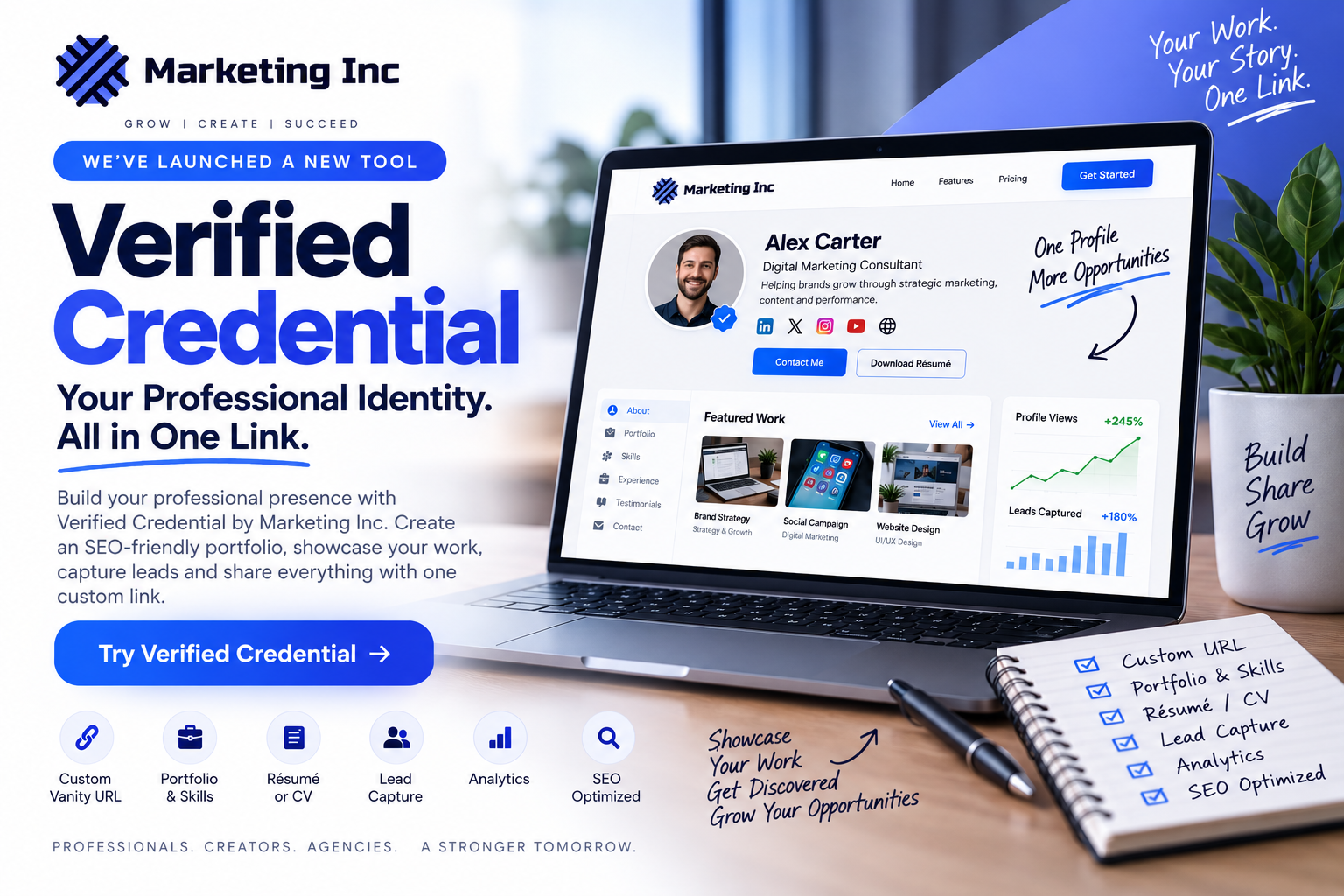
Verified Credential combines a professional profile, portfolio, resume, skills, contact information, social links, lead generation, analytics, and a custom URL into one shareable professional page.
For freelancers, consultants, creators, marketers, agency professionals, and other independent experts, that seemingly simple concept could solve an increasingly important problem: how do you turn your professional reputation into a digital asset that people can actually discover, understand, and act on?
Your Online Presence Is Becoming Your New Resume
Consider what happens after you meet a potential client.
You could send them your LinkedIn profile.
But LinkedIn is designed around LinkedIn's ecosystem.
You could send your resume.
But a resume doesn't necessarily demonstrate your work.
You could send your portfolio.
But your portfolio may not contain your complete professional background.
You could send your website.
But building and maintaining a professional website takes time and can become unnecessarily complicated for an individual consultant or freelancer.
As a result, many professionals end up sending several links:
"Here's my LinkedIn."
"Here's my portfolio."
"Here's my resume."
"Here are some examples of my work."
"Here's my email."
The information is available, but the experience is fragmented.
A better approach is to create a professional digital identity that brings those assets together.
That is essentially the idea behind a verified professional portfolio.
Instead of expecting someone to assemble your professional story from five different platforms, you give them one destination where they can quickly understand who you are, what you do, what you have accomplished, and how to contact you.
What Is a Verified Professional Portfolio?
A verified professional portfolio is more than a traditional portfolio website.
A portfolio usually answers one question:
What work have you done?
A professional profile answers another:
Who are you?
A resume answers:
What experience do you have?
A contact form answers:
How can someone reach you?
A modern professional credential should ideally answer all four.
Marketing Inc's Verified Credential has been designed around this approach. The platform provides a single professional page that can function as a portfolio, resume, credibility page, and lead-generation destination.
Users can create a professional profile, choose a custom vanity URL, showcase their portfolio and skills, upload a resume or CV, display social links and contact information, and allow visitors to submit leads directly through the profile.
The platform also provides analytics for profile views and leads and is designed with search engine optimization in mind.
Instead of simply creating another profile on another social network, the objective is to create a page that becomes a central destination for your professional identity.
Why Freelancers and Consultants Need More Than LinkedIn
LinkedIn remains incredibly useful for professional networking, but there is an important distinction between having a social profile and owning a focused professional presentation.
A potential client landing on your professional portfolio should not have to navigate a news feed, connection suggestions, advertisements, notifications, or unrelated content.
They should immediately see the information that helps them make a decision about you.
For a consultant, that might include expertise, industries served, case studies, previous work, and contact information.
For a designer, it might emphasize portfolio projects.
For a developer, it could showcase technical skills and applications built.
For a marketing professional, it might highlight campaigns, results, certifications, and client work.
A dedicated professional portfolio gives you more control over that journey.
That matters because personal branding is increasingly connected to conversion.
It isn't enough for someone to discover you.
They need to quickly understand why they should work with you.
One Link Can Simplify Your Personal Brand
One of the most useful elements of Verified Credential is its custom vanity URL.
A professional link can become the digital equivalent of a business card.
You can include it in your:
- Email signature
- LinkedIn profile
- Resume
- Social media bios
- Proposals
- Speaker profile
- Business cards
- Networking follow-ups
- Freelance marketplace profiles
- Conference materials
- Online communities
Instead of deciding which professional asset to share in every situation, you can direct people toward one central profile.
This is particularly useful for freelancers and consultants because business development often happens across multiple channels.
Someone might first encounter you through an X post, LinkedIn comment, conference conversation, referral, podcast, Google search, or cold email.
A professional portfolio provides a consistent destination regardless of where that discovery happens.
A Portfolio Should Generate Opportunities, Not Just Display Work
This is where professional portfolios need to evolve.
Traditional portfolio websites tend to be passive.
Someone visits.
They look at your projects.
They leave.
There may be no clear way to measure what happened.
Verified Credential takes a more marketing-oriented approach by incorporating lead capture directly into the profile.
Visitors who are interested in working with you can become inquiries rather than anonymous traffic.
That changes the role of a portfolio.
Your professional page isn't simply saying:
"Look at my work."
It can also say:
"If you like what you see, here's how we can work together."
For independent professionals, that distinction matters.
A portfolio should contribute to business development.
Understand Whether Your Personal Brand Is Actually Working
Analytics are another feature that separates a digital professional profile from a static resume.
Verified Credential includes analytics around profile views and leads.
Imagine attending a conference and sharing your professional URL with dozens of people.
You could subsequently see whether that exposure resulted in profile activity.
Or perhaps you add your credential link to your email signature.
Over time, you can better understand whether people are actually engaging with your professional presence.
For freelancers and consultants who increasingly treat themselves as a brand, these insights can become useful.
Businesses measure website traffic.
Creators measure audience engagement.
E-commerce companies measure conversions.
Professionals should increasingly think the same way about their own digital presence.
The SEO Advantage of Having a Professional Profile
Search visibility is another important consideration.
Search your own name.
What appears?
For some professionals, LinkedIn appears first.
For others, results might include social media accounts, an old company profile, conference appearances, or websites they no longer control.
Sometimes there is almost nothing.
That is not ideal when potential clients increasingly conduct online research before making purchasing or hiring decisions.
Verified Credential includes an SEO-optimized professional profile as part of its individual offering.
That means the page is intended to help create another relevant search result associated with your professional identity.
No platform can guarantee that a particular page will rank first on Google. Search rankings depend on numerous factors, including competition, authority, content, links, and search intent.
However, creating a structured, optimized page around your professional identity gives search engines another useful source of information about who you are and what you do.
That can be particularly valuable for professionals with specific expertise.
For example:
"Jane Smith healthcare marketing consultant"
"John Patel AI developer"
"Sarah Jones fractional CMO"
"David Chen SaaS consultant"
These types of searches have commercial intent.
Someone searching for your name plus your profession may already be considering contacting you.
A well-developed professional profile gives that person somewhere useful to land.
Show the Proof Behind Your Expertise
The internet has created another challenge for professionals: almost everyone can claim expertise.
Anyone can call themselves a strategist.
Anyone can write "AI expert" in a bio.
Anyone can claim to be a consultant.
That means proof is becoming more important than claims.
A strong professional profile should therefore communicate more than a job title.
It should demonstrate expertise through actual work.
Verified Credential allows professionals to showcase their portfolio and skills while also making a resume or CV available for viewing and download.
That combination can create a much stronger professional narrative.
Instead of saying:
"I'm an experienced marketing consultant."
You can show campaigns, projects, capabilities, experience, and professional history in the same place.
The principle is simple:
Don't just tell people what you can do. Make it easy for them to see the evidence.
What Does Verified Credential Cost?
One of the more interesting parts of the offering is the introductory pricing.
The individual Verified Credential plan is designed for freelancers and consultants.
It currently starts at $1 for the first month and then renews at $199 per year.
The individual plan includes a verified professional profile page, custom vanity URL, portfolio and skills showcase, resume/CV upload and download, visitor lead capture, analytics for profile views and leads, social links and contact information, and an SEO-optimized profile.
For someone who might otherwise pay for website hosting, portfolio software, analytics tools, lead forms, or website development separately, consolidating those capabilities into one professional platform can be attractive.
There is also an option specifically designed for agencies.
Agency Hub: A Professional Presence for Agencies
The same credibility problem applies to agencies, except at a larger scale.
An agency needs to communicate:
Who are you?
What services do you provide?
Who is on your team?
What work have you completed?
What results have you generated?
How can a client contact you?
What recognition have you received?
Marketing Inc addresses this through Agency Hub.
Agency Hub currently starts at $1 for the first month and then renews at $499 per year.
The package includes a verified agency profile, custom agency URL, team and services showcase, case studies and portfolio functionality, client lead capture and CRM capabilities, an agency analytics dashboard, award and recognition displays, and SEO optimization.
For small and growing agencies that don't want to constantly rebuild their main website simply to showcase new work, an agency-specific profile can become another useful acquisition and credibility channel.
Who Should Consider Using Verified Credential?
The platform makes the most sense for professionals whose reputation directly influences their ability to generate opportunities.
That includes freelancers, independent consultants, fractional executives, designers, developers, marketers, writers, photographers, creators, coaches, advisors, sales professionals, speakers, agency owners, and other specialists.
It can also be useful for professionals who already have a website.
The goal does not necessarily have to be replacing your website.
Instead, Verified Credential can become the portable version of your professional identity.
Your main website might contain dozens of pages.
Your LinkedIn account might contain years of activity.
Your resume might contain your complete employment history.
Your Verified Credential can serve as the concise page you send when someone asks:
"Where can I learn more about you?"
Professional Reputation Is Becoming Infrastructure
For years, companies invested heavily in their online reputation while individuals treated personal branding as optional.
That distinction is disappearing.
Consultants operate like businesses.
Creators operate like media companies.
Freelancers operate like agencies.
Employees build audiences.
Founders build public brands before their companies are established.
Professionals increasingly need their own digital infrastructure.
That infrastructure doesn't have to be complicated.
It needs to communicate credibility, demonstrate expertise, make information easy to discover, and provide a simple path toward contacting you.
That's why tools such as Verified Credential are interesting.
They reflect a larger shift in how professional reputation works online.
Your resume is no longer the entire story.
Your LinkedIn account isn't the entire story either.
Your professional identity is becoming something that exists across search, social, content, work history, reputation, and proof.
The opportunity is to bring those signals together.
Your Professional Identity Should Be Easy to Find and Easy to Trust
The strongest personal brands often feel effortless from the outside.
Search for someone and you immediately understand what they do.
Visit their profile and their best work is easy to find.
Want to contact them? There is an obvious next step.
Want to verify their experience? The information is available.
That experience doesn't happen accidentally.
It comes from intentionally building your professional presence.
Platforms like Marketing Inc are recognizing that modern marketing isn't limited to companies. Professionals increasingly need many of the same systems businesses use: search visibility, positioning, analytics, credibility, and conversion.
A Verified Credential professional profile brings several of those elements together into one shareable destination.
At $1 for the first month, the barrier to testing the platform is deliberately low. After that, individuals currently pay $199 per year, while agencies using Agency Hub pay $499 per year.
For freelancers, consultants, and agencies competing in markets where prospects routinely research providers before making contact, the bigger question may not be whether they need another profile.
It may be whether their current digital presence does enough to turn professional credibility into actual opportunities.
Because in an increasingly crowded digital economy, being talented isn't always enough.
People also need to be able to find you, understand you, trust you, and contact you.
And ideally, they should be able to do all four from one link.