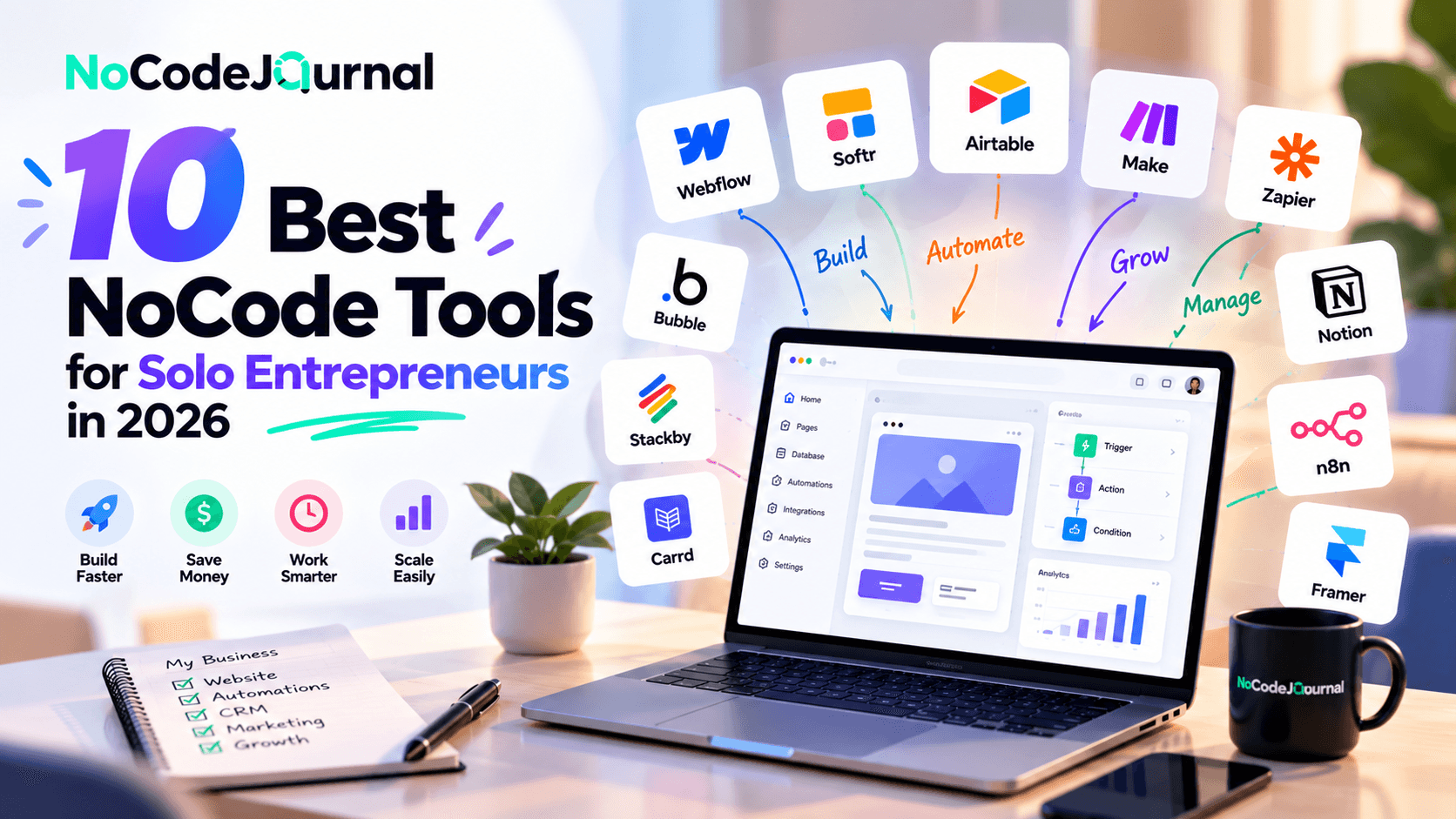
An accessible guide to building websites, automating tasks, managing customers, and starting a business without programming.
What Are the Best NoCode Tools for Beginners in 2026?
The best no-code tools for beginners in 2026 include Carrd for creating websites, Canva for graphic design, Notion for project management, Airtable for databases, and Zapier for workflow automation. Other beginner-friendly options include Calendly for scheduling, Tally for forms, MailerLite for email marketing, Glide for building business applications, and Stripe Payment Links for accepting payments. Most of these platforms offer free plans or low-cost starting options, making it easier for freelancers, entrepreneurs, and small businesses to build and manage digital workflows without programming knowledge.
10 Best NoCode Tools for Beginners: Pricing and Features (October 2026)
|
Tool |
Starting price |
Best for |
Key limitations |
|---|---|---|---|
|
Carrd |
Free; Pro Standard $19/year |
Landing pages and portfolios |
Free plan lacks custom domains and advanced forms |
|
Canva |
Free; paid plans vary by region |
Graphic design and marketing |
Premium assets and advanced AI features are limited |
|
Notion |
Free; Plus $10/user/month |
Projects, notes and documents |
Advanced collaboration and AI capabilities require upgrades |
|
Airtable |
Free; Team $20/user/month |
Databases and customer records |
Record limits and paid editor seats |
|
Zapier |
Free; Professional $19.99/month |
Workflow automation |
Task limits and restricted free-plan workflows |
|
Calendly |
Free; Standard $10/seat/month |
Appointment scheduling |
Free plan has limited event types and integrations |
|
Tally |
Free; Pro $29/month |
Forms and surveys |
Branding removal and custom domains require Pro |
|
MailerLite |
Free; paid plans vary by subscribers |
Email marketing |
Subscriber and email-sending limits |
|
Glide |
Free; Basic $25/month |
Internal apps and dashboards |
Free plan cannot publish apps; paid usage is credit-based |
|
Stripe Payment Links |
No monthly subscription required; from 2.9% + 30¢ per transaction |
Accepting online payments |
Transaction fees and country-specific eligibility |
Pricing checked October 16, 2026, in USD, except where regional prices apply. Airtable, Notion, Zapier, and Calendly paid prices are annual-billing equivalents; other billing terms vary. Stripe's example is for standard US domestic-card transactions.
Which NoCode Tool Should Beginners Choose?
The best no-code tool depends on what you want to create. For simple websites and landing pages, Carrd is an affordable starting point, while Canva makes it easy to create professional marketing graphics without design experience.
For managing projects and business information, Notion and Airtable provide flexible solutions. Zapier is useful for connecting applications and automating repetitive work, while Calendly, Tally, and MailerLite help businesses manage appointments, collect information, and communicate with customers.
Beginners who want to build data-driven applications can explore Glide, while Stripe Payment Links offers a straightforward way for eligible businesses to accept online payments without developing their own checkout system.
Our recommendation: Start with one or two free tools that solve your immediate problem. Upgrade only when you need additional integrations, automation capacity, collaboration features, or higher usage limits.
What Are NoCode Tools?
No-code tools let people build digital experiences and workflows without writing traditional programming code.
They typically use three elements:
-
Visual editors: Design pages, forms, and applications through interactive interfaces.
-
Templates: Start with layouts and workflows that can be customized.
-
Integrations and automations: Connect applications and move information between them.
For example, a consultant can create a website, collect inquiries, store leads, and schedule appointments with minimal custom development.
However, no-code doesn't always mean no learning curve. Simple website builders can be easy to adopt, while sophisticated applications still require planning, data management, and testing.
The 10 Best NoCode Tools for Beginners
1. Carrd — Best for Simple Landing Pages
Carrd is designed for creating responsive, single-page websites.
It is particularly useful for freelancers, consultants, and creators who need a straightforward online presence.
A beginner could create a portfolio containing a short biography, examples of work, and a contact form without managing a complicated development environment.
Best for: Landing pages, portfolios, and simple service websites.
For larger websites with more page templates or built-in business features, Wix may also be worth evaluating.
2. Canva — Best for Visual Content
Canva helps users create graphics, presentations, marketing materials, and other visual content.
Its template-based editor makes design more accessible to people without professional design experience.
A small bakery, for example, could use Canva to prepare menus, promotional graphics, and social media posts with consistent branding.
Best for: Marketing materials, graphics, presentations, and basic brand assets.
3. Notion — Best for Organizing Work
Notion brings notes, documents, databases, and project information together in one workspace.
Beginners can start with a task list or content calendar before moving into more structured databases.
A freelance writer might track clients, deadlines, drafts, and research in a single workspace.
Best for: Project planning, documentation, content calendars, and personal organization.
4. Airtable — Best for Managing Business Data
Airtable combines familiar spreadsheet-style interfaces with structured databases.
It can help organize customers, inventory, events, projects, and operational information.
For example, an event planner could maintain related records for clients, vendors, budgets, and upcoming events, then create filtered views for different workflows.
Best for: Customer information, operational tracking, and structured business data.
5. Zapier — Best for Workflow Automation
Zapier connects different software applications and runs workflows based on triggers and actions.
Suppose a customer submits a form on your website. Zapier can pass that information to a compatible database or email application, reducing manual copying.
Start with a single automation, test it carefully, and expand only when necessary.
Best for: Lead capture, notifications, data transfer, and repetitive administrative tasks.
6. Calendly — Best for Appointment Scheduling
Calendly lets customers and contacts book available meeting times.
For a consultant or tutor, this can replace multiple emails coordinating appointments.
Availability rules, connected calendars, and supported reminders help organize the booking process.
Best for: Discovery calls, consultations, tutoring sessions, and client meetings.
7. Tally — Best for Forms and Registrations
Tally provides a document-like interface for creating forms.
You can collect customer inquiries, survey responses, workshop registrations, and project requirements.
For instance, a freelance designer could ask prospective clients about their project goals, budget, and preferred timeline before scheduling a call.
Best for: Contact forms, surveys, feedback, and client intake.
8. MailerLite — Best for Email Marketing
MailerLite supports newsletters, email campaigns, subscriber management, and automation.
A creator could use a signup form to collect subscribers and share regular updates or useful educational content.
When building email lists, obtain appropriate consent, protect subscriber information, and provide unsubscribe options where required.
Best for: Newsletters, email sequences, and subscriber communication.
9. Glide — Best for Data-Driven Business Apps
Glide allows users to create applications around structured information.
A small property-management company, for example, could create an internal interface to track properties, maintenance tasks, and requests.
It's useful when ordinary spreadsheets are becoming difficult for users to navigate.
Best for: Internal tools, dashboards, directories, and operational applications.
For more advanced database-driven web applications, Bubble may be worth investigating, although it generally requires more time to learn.
10. Stripe Payment Links — Best for Collecting Payments
Stripe Payment Links allows eligible businesses to create hosted checkout links without building a custom payment system.
A freelance designer could create a payment link for a fixed-price service and share it with customers.
Available payment methods, pricing, and eligibility vary by location and account configuration.
Best for: Service payments, digital products, and straightforward checkout workflows.
Comparison: Which NoCode Tool Should You Start With?
| Your goal | Start with |
|---|---|
| Create a one-page website | Carrd |
| Design marketing graphics | Canva |
| Organize tasks and documents | Notion |
| Manage customer records | Airtable |
| Connect apps and automate tasks | Zapier |
| Schedule meetings | Calendly |
| Collect customer information | Tally |
| Send newsletters | MailerLite |
| Build an internal application | Glide |
| Accept online payments | Stripe Payment Links |
You do not need all ten tools. Choose one or two that solve a real problem, and expand from there.
Build Your First NoCode Business Workflow
Imagine you're starting a consulting business.
Step 1: Create an online presence. Use Carrd for a landing page explaining your services.
Step 2: Collect inquiries. Build a short form in Tally asking prospects about their requirements.
Step 3: Organize leads. Store relevant inquiry information in Airtable.
Step 4: Automate administration. Connect compatible tools through Zapier to reduce repetitive data entry.
Step 5: Schedule conversations. Offer a Calendly booking link to prospects who are ready for a consultation.
Step 6: Collect payments. Use Stripe Payment Links if your business and payment model are supported.
Step 7: Manage delivery. Organize project tasks, meeting notes, and deliverables in Notion.
This example illustrates how several simple applications can work together. Each integration should be tested before using it with real customer data.
How to Choose the Right NoCode Platform
Start with the problem, not the product
Write down what you are trying to accomplish. A landing page and a complex customer portal require different tools.
Consider the learning curve
Easy-to-use interfaces can still become complex when you introduce permissions, databases, integrations, or conditional workflows.
Review long-term costs
Some platforms provide free plans or trials, but features, limits, and pricing can change. Check official pricing before making a decision.
Check data portability
Understand whether you can export information, move to another provider, and maintain access to your business records.
Evaluate security
If you're storing personal or business information, review account permissions, authentication, and data-handling settings.
Common Mistakes Beginners Should Avoid
Using too many tools: An oversized software stack can become expensive and difficult to maintain.
Automating inefficient processes: Simplify a workflow before automating it.
Ignoring mobile usability: Test websites and forms on phones as well as desktop screens.
Overlooking privacy: Collect only information you need and protect access to customer data.
Assuming no-code requires no maintenance: Integrations, permissions, subscriptions, and application behavior still need ongoing attention.
When NoCode May Not Be Enough
No-code platforms are practical for many websites, internal tools, and routine workflows. However, they may be less suitable when an application requires complex business logic, specialized integrations, high levels of customization, or strict technical and regulatory requirements.
At that stage, low-code development or custom software may offer greater flexibility.
The decision should be based on requirements rather than the assumption that one approach is always better.
Frequently Asked Questions
Can beginners use NoCode without programming knowledge?
Yes. Many platforms are designed for nontechnical users. More advanced features may still require understanding data models, logic, and integrations.
Are NoCode tools free?
Some offer free plans or trials. Others require subscriptions or transaction fees. Always confirm current limits and prices.
Can I build a business using only NoCode tools?
Many small businesses can manage substantial portions of their operations with no-code software. Specialized functionality may still require technical development.
How long does it take to learn NoCode?
A simple form or landing page might be learned relatively quickly. Complex applications and multi-step automations can require significantly more practice.
Which NoCode tool should I learn first?
Start with the tool that addresses your most immediate need. For a website, consider Carrd or Wix. For automation, consider Zapier. For organizing structured business data, consider Airtable.
Final Thoughts
NoCode tools are most valuable when they solve specific problems rather than simply adding more software to your workflow.
Carrd, Canva, Notion, Airtable, Zapier, Calendly, Tally, MailerLite, Glide, and Stripe Payment Links provide different building blocks for starting and operating a business.
Start with a simple project, test the result, and improve it as your needs evolve.
You don't need to master every platform to benefit from no-code. You need a clear problem, an appropriate tool, and a willingness to experiment.