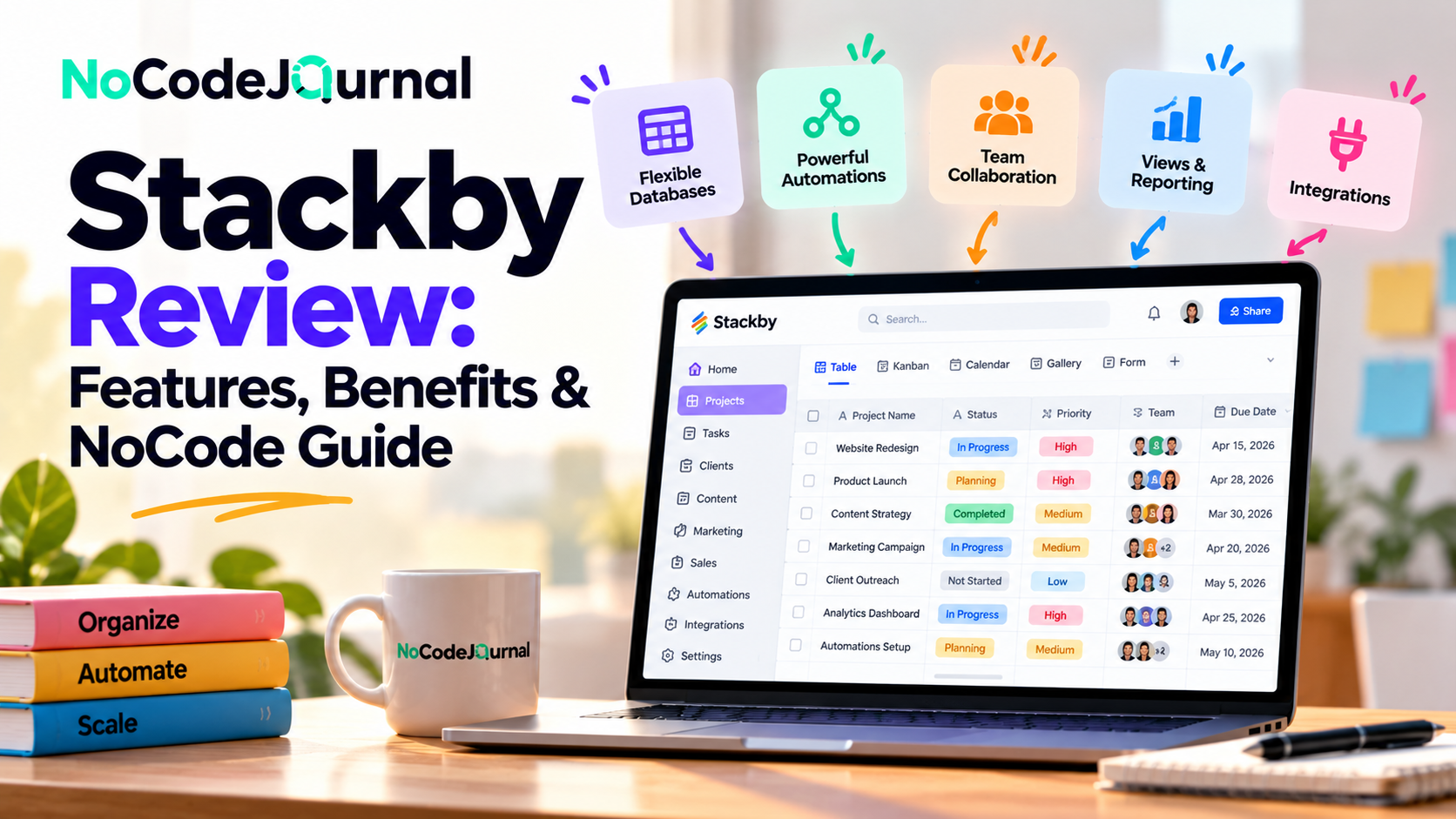
Managing business information should be simple. Yet many businesses struggle with scattered spreadsheets, disconnected applications, and repetitive manual tasks.
Imagine running a business where customer records sit in one spreadsheet, project deadlines in another, and marketing performance reports across several different platforms.
Keeping everything organized can quickly become overwhelming.
What if you could manage all this information in one place without learning complicated programming languages?
That's where Stackby, a NoCode database and workflow management platform, comes into the picture.
Stackby combines the familiarity of spreadsheets with the functionality of relational databases, automation tools, AI capabilities, and customizable dashboards.
It helps entrepreneurs, freelancers, startups, and business teams organize information and create workflows that match their specific needs.
In this guide, we'll explore what Stackby is, its most important features, practical use cases, benefits, pricing considerations, and how to get started.
What Is Stackby?
Stackby is a NoCode work management platform that combines spreadsheets, databases, automation, integrations, and AI-assisted functionality in one environment.
The platform allows users to organize business information using familiar tables while taking advantage of more advanced database capabilities.
Unlike traditional spreadsheets, Stackby supports relationships between tables, customizable data views, workflow automation, and connections with third-party services.
Users can create applications for customer relationship management, project tracking, marketing operations, inventory management, and many other business activities.
Why Was Stackby Created?
Stackby was founded to address a common business problem: organizations frequently rely on spreadsheets even when their operational requirements have become more complex.
Spreadsheets are useful for storing and analyzing information, but they can become difficult to manage when businesses need connected records, automated workflows, and collaboration.
Stackby aims to bridge this gap.
It provides a familiar spreadsheet-style experience while introducing database functionality that helps users organize relationships between different types of information.
The goal is to make customized business systems accessible without requiring extensive technical knowledge.
If you're new to visual development, our guide on the benefits of NoCode development explains why platforms like Stackby are becoming valuable business tools.
How Does Stackby Work?
Stackby organizes information using workspaces, stacks, tables, and records.
A workspace provides an environment for organizing related business activities.
Within a workspace, users can create stacks containing tables for specific purposes.
Each table stores records, while columns define the information associated with those records.
For example, a marketing agency could create a workspace containing customer information, campaigns, deliverables, and performance reports.
Team members could then connect relevant records and view information in different layouts.
Instead of managing multiple disconnected spreadsheets, the agency would have a more centralized operational system.
Let's explore the features that make this possible.
1. Spreadsheet-Style Database Management
One of Stackby's most important features is its combination of spreadsheet simplicity and relational database functionality.
The platform looks familiar to users who have worked with Microsoft Excel or Google Sheets.
However, it offers additional capabilities for organizing and connecting information.
Customizable Data Fields
Stackby supports different column types for storing information.
These include text, numbers, attachments, formulas, linked records, dropdown selections, and other specialized fields.
For example, an inventory database could contain product names, stock quantities, supplier information, product images, and pricing details.
Instead of forcing businesses into a fixed structure, Stackby allows them to customize fields around their requirements.
Relational Database Capabilities
Relational databases allow information in different tables to be connected.
Imagine a consulting business with separate tables for clients and projects.
A single client might have multiple active projects.
By linking these records, the business can access related information without repeatedly entering the same details.
This improves organization and reduces unnecessary duplication.
Best for: Businesses that have outgrown basic spreadsheets but don't want to develop custom database software.
2. Multiple Views for Organizing Work
Different business activities require different ways of visualizing information.
A sales manager might prefer a pipeline layout, while a project manager may need a calendar.
Stackby supports multiple views that allow users to display the same underlying information differently.
Grid View
Grid view provides a traditional spreadsheet-style layout.
It's useful for reviewing records, editing information, and managing large datasets.
Kanban View
Kanban organizes records into columns based on status or another selected field.
A sales team could create stages such as New Lead, Contacted, Proposal Sent, and Closed.
Records can then be organized according to their current stage.
Calendar View
Calendar layouts help users visualize date-based information.
Marketing teams can plan campaigns, content creators can schedule publications, and project managers can track deadlines.
Gallery View
Gallery layouts are useful when visual information matters.
Examples include creative portfolios, product catalogs, and marketing asset libraries.
Stackby also offers additional layouts, with availability depending on the platform's current features and plan.
These views help employees work with the same information in ways that suit their responsibilities.
3. NoCode Workflow Automation
Manual work can consume significant time.
Employees may repeatedly update records, send notifications, check deadlines, or transfer information between applications.
Stackby offers workflow automation features that can help reduce these repetitive activities.
How Stackby Automation Works
Automations generally involve two components:
Triggers: Events that start an automation.
Actions: Activities performed after the trigger occurs.
For example, an automation could begin when a new record is added to a customer database.
The system might then send a notification or create another related record.
Stackby's automation features include triggers based on record creation, record updates, form submissions, scheduled times, and other supported conditions.
Available actions include updating records, creating records, and sending selected notifications.
Practical Example: Lead Management
Imagine a digital marketing agency collecting inquiries from potential customers.
Without automation, employees might need to manually monitor submissions and assign leads.
With an appropriately configured Stackby workflow:
-
A potential customer submits an inquiry form.
-
A new lead record is created.
-
The record is assigned to the appropriate team member.
-
A notification is triggered.
-
The lead progresses through the sales pipeline.
This process can improve consistency while reducing manual coordination.
Stackby's official automation documentation explains supported triggers, actions, testing, and workflow execution.
4. Integration With Popular Business Applications
Modern businesses depend on multiple software services.
A marketing team may use different platforms for advertising, analytics, communication, and customer management.
Switching between these services can make reporting time-consuming.
Stackby offers integrations that help bring selected information into its database environment.
API-Powered Data Connections
APIs allow software applications to exchange information.
Stackby provides API-connected columns and integrations with supported external services.
For example, marketing users can explore integrations for retrieving information from services such as YouTube, Ahrefs, and other available providers.
Instead of manually copying information into spreadsheets, teams can configure supported integrations to retrieve data.
Connecting With Automation Platforms
Stackby also supports connections through third-party automation services such as Zapier and Make.
These platforms can extend workflow possibilities by connecting Stackby to additional applications.
For example, a business could connect a lead-generation form to Stackby through an automation platform.
The resulting customer record could then become part of a broader sales-management process.
Integration capabilities depend on the external service, subscription plan, and available API functionality.
5. Forms for Collecting Information
Collecting information is essential for business operations.
Organizations regularly need forms for customer inquiries, event registration, employee onboarding, surveys, and internal requests.
Stackby provides form-building capabilities that connect collected information with database records.
Why Integrated Forms Matter
Imagine an event organizer collecting registrations.
Without an integrated system, the organizer might receive submissions through one tool and manually transfer the information into another.
With Stackby forms, submissions can be organized directly within a connected database.
This simplifies record management and helps reduce repetitive data entry.
Common Uses for Stackby Forms
Businesses can create forms for customer feedback, contact inquiries, service requests, employee information, and project submissions.
Advanced form functionality may include conditional fields and customization options, depending on the selected plan.
Forms are especially useful when combined with automation.
For example, submitting a new request could trigger an internal notification.
6. Dashboards and Business Reporting
Collecting information is only useful when businesses can understand and act on it.
Stackby offers dashboard and reporting capabilities that help transform records into visual summaries.
Its Apps Marketplace includes tools for displaying information through charts, pivot tables, summary boxes, and other components.
Example: A Marketing Dashboard
Imagine a digital agency managing several customer campaigns.
The agency needs to monitor campaign activity, ongoing tasks, and performance metrics.
Rather than manually compiling reports from different spreadsheets, it could create dashboards using information stored in Stackby.
Managers could review progress, identify outstanding tasks, and monitor selected indicators.
Benefits of Visual Reporting
Dashboards can help businesses:
-
Identify operational bottlenecks.
-
Monitor project progress.
-
Review customer activity.
-
Track performance indicators.
-
Improve reporting consistency.
However, reporting quality depends on accurate data and properly configured integrations.
A dashboard doesn't automatically guarantee that its information is complete or current.
7. AI-Powered Databases and Workflows
Artificial intelligence is becoming an increasingly important part of NoCode development.
Stackby has introduced AI-related functionality, including AI field agents and an AI Co-builder.
These tools are designed to help users create workflows and process information more efficiently.
AI Co-builder
Stackby's AI Co-builder allows users to describe certain database or application requirements through prompts.
For example, a user might request a project tracker containing tasks, deadlines, owners, and progress statuses.
AI-assisted tools can help generate a starting structure that users can customize.
AI Fields
AI-powered fields can support activities such as generating content, analyzing information, and processing selected data.
Stackby describes integrations with AI model providers including OpenAI, Anthropic, and Google.
Depending on configuration, users may need to connect their own API keys.
Why AI Matters for Business Users
AI assistance can reduce the effort required to configure databases and process repetitive information.
However, AI-generated results should still be reviewed.
Incorrect data, unexpected outputs, and privacy considerations can create problems if organizations rely on automated results without appropriate checks.
8. Real-Time Team Collaboration
Business information becomes more useful when employees can access and update it together.
Stackby includes collaboration features that help teams work within shared databases.
Users can manage records, leave comments, assign responsibilities, and coordinate activities.
Example: Project Collaboration
Consider a product development team managing a new software launch.
Designers, marketers, and project managers may all need access to project information.
Using a shared Stackby workspace, the team can organize tasks, track responsibilities, and monitor progress.
A designer might update a task's status after completing a visual asset.
The project manager could review the update without requesting another spreadsheet.
This centralization can reduce communication delays.
Organizations should still configure access permissions appropriately to protect confidential information.
9. Ready-Made Templates for Faster Setup
Starting with an empty database can feel intimidating.
Stackby provides templates designed for different business use cases.
These templates help users understand how information should be structured and reduce initial setup work.
Examples include:
-
Sales CRM systems.
-
Project trackers.
-
Content calendars.
-
Marketing campaign trackers.
-
Employee management databases.
-
Product roadmaps.
-
Inventory records.
Why Templates Help Beginners
Imagine an entrepreneur who wants to organize customer relationships.
Instead of designing every table and field independently, they could begin with a CRM template.
The entrepreneur could then customize the structure by adding relevant fields, changing statuses, and removing unnecessary components.
Templates are starting points rather than complete solutions for every organization.
Users should review the default structure before storing real business information.
10. Mobile Access and Flexible Work Management
Many professionals work outside traditional offices.
Sales representatives visit customers, project managers travel between sites, and entrepreneurs often manage their businesses remotely.
Stackby provides mobile access options to help users review and manage information while away from their desks.
Supporting Remote Work
Consider a field service business.
Employees may need to update customer details, review assigned tasks, or record job progress.
Access to shared business records can reduce dependence on office-based spreadsheets.
However, the available functionality and experience may differ between mobile and desktop environments.
Teams should test their most important workflows before depending on mobile access for daily operations.
Practical Use Cases for Stackby
Stackby's flexibility makes it suitable for different types of businesses.
Customer Relationship Management
A small business can organize leads, maintain customer records, and track sales opportunities.
Custom fields allow teams to capture information relevant to their sales processes.
Content Marketing
Marketing teams can create editorial calendars, track content production, and organize campaign assets.
They can use calendar and Kanban views to monitor upcoming publications.
Businesses looking to connect these processes with lead generation can read our guide on building a marketing funnel without code.
Project Management
Teams can track tasks, deadlines, project owners, and status updates.
Custom views can help different departments monitor the same project from different perspectives.
Recruitment Management
HR teams can organize candidate information, interview stages, and recruitment activities.
Forms can also support collecting relevant application information.
Inventory Tracking
Businesses can create product records, monitor stock quantities, and organize supplier information.
Agency Operations
Agencies can manage clients, projects, deliverables, and performance reports within a connected workspace.
These examples demonstrate why Stackby can be useful across different industries.
How to Get Started With Stackby
Beginners can approach Stackby through a simple step-by-step process.
Step 1: Create Your Account
Visit Stackby's official website and review the available registration options.
Choose a plan that matches your initial requirements.
Step 2: Create a Workspace
Set up a workspace for your business or project.
Organize related activities together to make information easier to manage.
Step 3: Choose a Template or Start From Scratch
Select a template that matches your intended workflow.
Alternatively, create a custom stack if you have specific requirements.
Step 4: Configure Tables and Fields
Add the information your project needs.
For a sales CRM, you might create fields for customer names, email addresses, deal stages, and follow-up dates.
Step 5: Select Your Views
Choose the most useful layouts for reviewing information.
A sales pipeline may benefit from Kanban, while appointment-related records may be easier to manage through a calendar.
Step 6: Add Forms and Automations
Introduce forms for collecting information and configure automations for repetitive processes.
Test each automation before activating it for real business operations.
Step 7: Invite Team Members
Share access with authorized collaborators.
Configure permissions based on responsibilities.
Step 8: Review and Improve
Monitor how the database performs during actual use.
Refine fields, views, and workflows as requirements evolve.
Stackby's official getting started with Stackby tutorial provides additional onboarding guidance.
What Are the Benefits of Using Stackby?
Stackby can provide several advantages for businesses that rely heavily on spreadsheets and disconnected applications.
Centralized information: Store related business records in one system.
Flexible customization: Build databases around existing business processes.
Reduced manual work: Automate selected tasks and notifications.
Improved collaboration: Share updated information with authorized employees.
Better visibility: Use dashboards and alternative views to monitor work.
Faster setup: Begin with existing templates instead of developing everything from scratch.
AI assistance: Use supported AI tools to help build structures and process information.
These benefits depend on implementation quality and the suitability of the platform for each use case.
Stackby vs. Traditional Spreadsheets
Spreadsheets remain valuable for calculations, analysis, and straightforward data organization.
However, they may become difficult to maintain when several teams depend on connected information.
| Feature | Traditional Spreadsheets | Stackby |
|---|---|---|
| Data organization | Rows and columns | Spreadsheet-style relational databases |
| Linked information | Formulas or manual references | Linked records and relationships |
| Visual layouts | Primarily grid-based | Grid, Kanban, calendar, gallery, and more |
| Automation | Varies by platform and scripts | Built-in triggers, actions, and integrations |
| Dashboards | Charts and reporting tools | App-based dashboards and reporting |
| Data collection | Forms or integrations | Built-in form capabilities |
| Collaboration | Available in cloud spreadsheets | Shared database collaboration |
Stackby may be especially valuable when an organization needs a structured operational database rather than a standalone spreadsheet.
Stackby vs. Airtable and Retool
Stackby, Airtable, and Retool all help businesses create customized tools, but they emphasize different capabilities.
Stackby focuses on spreadsheet-style databases, connected records, workflow automation, and business applications.
Airtable provides relational database features, interfaces, automations, and application-building functionality.
Retool emphasizes custom application interfaces, integrations, and developer-oriented internal tools.
The best platform depends on the complexity of the application, required integrations, and available technical expertise.
For a closer look at developer-oriented business applications, explore our article on Retool's NoCode and low-code capabilities.
Stackby Pricing: What Should You Consider?
Stackby offers different subscription options, including an advertised free plan.
Paid plans may provide higher limits or additional functionality.
Before selecting a subscription, consider:
-
Number of records required.
-
Available database storage.
-
Automation execution limits.
-
Number of collaborators.
-
Integration requirements.
-
AI-related usage costs.
-
Dashboard and application capabilities.
-
Administrative controls.
The cost of the platform may increase as business usage expands.
Organizations should review current pricing directly before purchasing because plan features and limits can change.
Avoid choosing a platform based solely on the lowest monthly subscription price.
Instead, evaluate its total cost relative to the business problems it solves.
Limitations of Stackby
Although Stackby offers extensive NoCode functionality, it won't be ideal for every project.
Learning Advanced Database Concepts
Beginners may need time to understand linked records, formulas, and complex workflows.
Integration Restrictions
Some external services may require paid plans, separate subscriptions, or API configuration.
Automation Limits
Automation execution allowances can vary by plan.
Platform Dependency
Organizations should understand how to export important information and migrate workflows if required.
Complex Applications
Highly specialized applications may still require custom development.
Security Responsibilities
Businesses must configure appropriate permissions and review how sensitive information is handled.
NoCode tools simplify development, but they don't eliminate the need for governance and ongoing maintenance.
How Stackby Can Help Startups and Small Businesses
Startups often operate with limited resources.
They need practical tools for organizing customers, tracking projects, and monitoring operations.
Building custom software for every internal requirement may not be financially practical.
Stackby offers a way to create structured workflows using existing platform capabilities.
For example, an early-stage startup could manage customer discovery interviews, product feature requests, and sales opportunities in connected databases.
As its processes evolve, the team could introduce forms, automation, and reporting.
This approach allows a startup to experiment with its internal operations before investing in more specialized systems.
For additional ideas on customer acquisition and business experimentation, explore our article on growth hacking strategies for global startups.
The Future of Stackby and NoCode Work Management
NoCode platforms are increasingly combining traditional database functionality with automation and artificial intelligence.
Stackby's newer capabilities reflect this direction through AI-assisted database creation, AI fields, and customizable business workflows.
These tools could make it easier for non-technical professionals to create applications that reflect their operational needs.
However, the value of these platforms depends on more than their technical features.
Businesses must still understand their workflows, organize information properly, and measure whether automation improves actual results.
As NoCode technology develops, organizations will have more opportunities to create tailored internal systems without building every component from scratch.
Conclusion: Is Stackby Worth Trying?
Stackby is a useful option for individuals and businesses looking to move beyond traditional spreadsheets.
Its combination of relational databases, flexible views, forms, automation, integrations, dashboards, and AI-assisted tools supports a wide range of business workflows.
For entrepreneurs and small teams, it can provide a practical way to organize information and reduce repetitive work.
For growing organizations, its customization features can help bring related processes into a shared system.
However, businesses should evaluate pricing, integrations, security requirements, and long-term scalability before making a commitment.
The best way to evaluate Stackby is to begin with one specific workflow, create a small database, and test how effectively the platform supports your requirements.
The real advantage of Stackby isn't simply replacing spreadsheets. It's making business information more connected, useful, and actionable without requiring extensive coding knowledge.
Frequently Asked Questions
What is Stackby used for?
Stackby is used for creating customizable databases, managing projects, organizing customer information, automating workflows, and building business dashboards.
Is Stackby a NoCode platform?
Yes. Stackby provides visual database, application, and automation tools that allow users to create many business workflows without traditional programming.
Is Stackby suitable for beginners?
Yes. Its spreadsheet-style interface and templates can make it approachable for beginners, although advanced workflows require additional learning.
Can Stackby replace Excel or Google Sheets?
Stackby can replace some spreadsheet-based business workflows, particularly those requiring linked records, automation, and multiple data views. Traditional spreadsheets may still be preferable for certain analytical tasks.
Does Stackby offer automation?
Yes. Stackby supports automation triggers and actions for activities such as record updates, form submissions, and selected notifications.
Can Stackby integrate with other applications?
Yes. Stackby offers native integrations and supports connections through external automation platforms such as Zapier and Make.
Does Stackby include AI features?
Yes. Stackby advertises AI-powered fields and an AI Co-builder for supported database and workflow tasks.
Is Stackby free to use?
Stackby advertises a free plan alongside paid subscription options. Feature limits and pricing should be confirmed on its official website.
Who should use Stackby?
Stackby may be suitable for startups, freelancers, marketing agencies, sales teams, project managers, and businesses that need customizable operational databases.