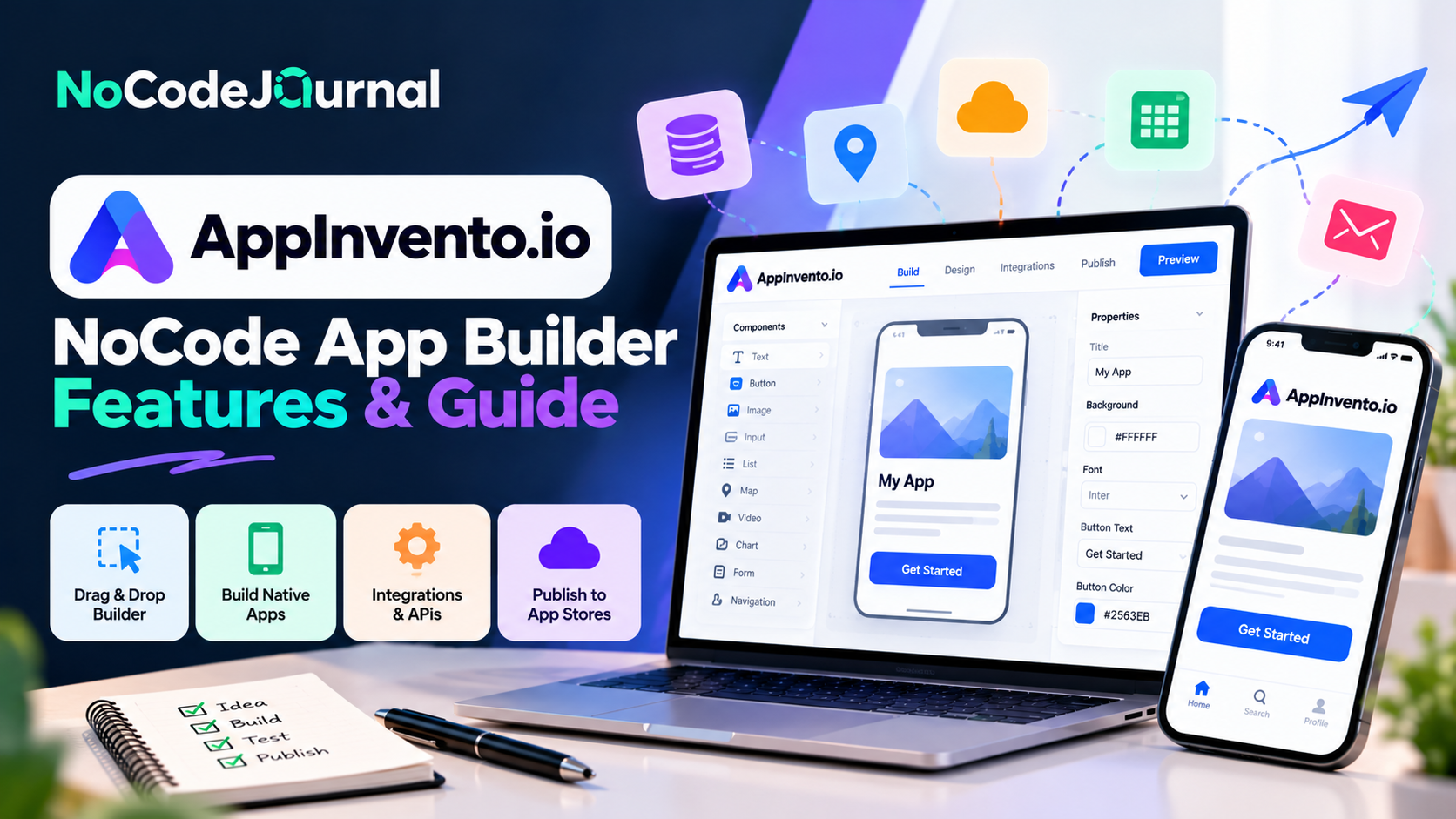
Have you ever imagined building your own application but felt overwhelmed by programming languages, databases, and complicated development processes?
Maybe you're an entrepreneur with an innovative startup idea, a business owner hoping to automate operations, or a creator interested in developing a digital product.
Traditionally, building applications required specialized technical knowledge, development resources, and significant time.
But what if you could simplify much of that process?
Meet AppInvento.io, a NoCode application development platform designed to help users create software with less manual coding.
AppInvento offers tools for generating backend functionality, configuring databases, managing authentication, and developing application interfaces. Its broader platform also introduces AI-assisted application creation.
Instead of building every technical component from scratch, users can work with visual tools, configuration options, and automated code generation.
In this guide, we'll explore what AppInvento.io is, its key features, benefits, practical applications, and how it can help entrepreneurs and development teams bring ideas to life.
What Is AppInvento.io?
AppInvento.io is a NoCode and code-generation platform that helps users build web applications by simplifying common software development tasks.
Its tools are designed to reduce the amount of manual programming needed for application creation.
Rather than writing every backend component individually, users can configure project requirements and generate supporting code.
The platform includes capabilities for creating database structures, defining API routes, managing authentication, and generating application components.
AppInvento also provides React-based interface-building capabilities for creating visual layouts.
Its evolving application platform introduces AI-powered development features aimed at generating full-stack applications from natural-language instructions.
How Is AppInvento Different From Traditional Development?
Traditional application development involves several interconnected activities.
Developers must create user interfaces, configure databases, establish server-side functionality, implement authentication, and connect different services.
Each stage requires planning, testing, and implementation.
AppInvento simplifies selected parts of this process through automated code generation and visual configuration.
For example, instead of manually writing common API endpoints, users can define their database structure and configure the desired routes.
The platform can then generate relevant backend code.
This approach is particularly useful for reducing repetitive development work.
To understand why visual development is gaining attention, read our article on the benefits of NoCode development.
Why Are NoCode App Builders Becoming Popular?
Businesses increasingly need software to manage operations, connect with customers, and introduce digital services.
However, building applications through traditional methods can involve substantial development effort.
NoCode platforms aim to make software creation more accessible and efficient.
Faster Development
Visual builders and code generators can reduce time spent creating common application components.
Reduced Technical Complexity
Users can configure functionality through interfaces rather than manually implementing every detail.
More Accessible Prototyping
Entrepreneurs can experiment with application concepts before investing in extensive custom development.
Greater Development Flexibility
Some platforms generate code that developers can review, customize, and extend.
More Time for Innovation
By simplifying repetitive technical tasks, teams can focus on features that distinguish their applications.
AppInvento combines several of these advantages through backend code generation, visual development, and AI-assisted functionality.
Key Features of AppInvento.io
Understanding a platform's features helps determine whether it matches your project requirements.
Here are the important capabilities AppInvento offers.
1. NoCode Backend Development
Backend development is one of the most technically demanding parts of creating an application.
The backend manages data, authentication, business logic, and communication between different components.
Traditionally, developers create these systems using programming languages and frameworks such as Node.js and Express.js.
AppInvento offers a backend builder designed to automate common development activities.
Users can define database structures, configure routes, and generate supporting code.
Why Backend Automation Matters
Imagine you're creating a customer-management application.
You need a system to store customer records, retrieve information, update details, and manage user permissions.
Without automation, developers would need to implement and test these components manually.
AppInvento can help generate the underlying structure based on project configurations.
This can reduce repetitive coding and provide a starting point for further development.
However, developers should still review the generated code and test business-specific requirements before deployment.
2. Automatic API Generation
Application programming interfaces, commonly known as APIs, allow software systems to communicate.
For example, when a mobile application displays account information, it may retrieve that data from a backend service through an API.
Creating APIs manually requires defining routes, implementing request handling, validating inputs, and managing errors.
AppInvento provides API generation capabilities that simplify part of this process.
How API Generation Helps
Consider an online inventory management application.
The application needs functionality for adding products, retrieving stock information, updating quantities, and removing obsolete records.
AppInvento's backend tools can help generate APIs around configured data structures and routes.
This reduces the need to create every standard operation individually.
The platform also supports custom routes for applications requiring more specialized functionality.
Automatic API generation can be especially valuable for developers building multiple applications with similar backend requirements.
3. Database Schema Configuration
Almost every dynamic application depends on a database.
Databases store information such as customer accounts, product details, order histories, and transaction records.
Designing these structures usually requires understanding data models and relationships.
AppInvento allows users to configure database schemas as part of the backend development process.
Example: Building a Customer Database
Suppose you're developing a service-booking application.
You might need collections or data structures for customers, services, appointments, and employees.
Through the platform's configuration tools, you can define the information each structure needs.
The generated backend can then use those definitions to support application functionality.
This approach provides a more guided starting point for database-driven development.
However, careful data modeling remains essential.
Poorly organized data structures can still create performance and maintenance problems regardless of the development platform.
4. Authentication and Authorization
Many applications require users to create accounts and sign in.
Authentication verifies a user's identity, while authorization determines which information and actions that user can access.
AppInvento provides functionality for configuring authentication and user roles.
Its documentation also describes add-ons for selected login methods.
A Practical Example
Imagine an application with three types of users:
-
Administrators who manage the system.
-
Employees who update operational records.
-
Customers who view their personal information.
Each user category requires different permissions.
AppInvento's role and authorization features can help establish this access structure.
Security configurations must still be carefully reviewed and tested.
In particular, production applications should validate permissions on the backend rather than relying only on interface restrictions.
5. Visual React.js Builder
An application's frontend is the part users interact with.
It includes pages, buttons, forms, menus, and other visual elements.
AppInvento provides a React.js Builder designed to help create interfaces through visual tools.
Users can arrange elements using drag-and-drop functionality and generate supporting React components.
Why Visual Interface Development Is Useful
Consider a startup building an internal reporting dashboard.
The team might need navigation menus, data tables, interactive buttons, and reporting sections.
A visual builder can help create the initial interface more efficiently.
Developers can then connect the interface to backend services and implement additional functionality.
This combination of visual design and generated code helps bridge the gap between NoCode development and traditional programming.
If you're exploring simpler website-building options, our guide on how to build your dream website without coding explains another approach to creating digital experiences.
6. Source Code Generation
One of AppInvento's distinguishing features is its emphasis on generating application source code.
Some NoCode platforms primarily provide applications that operate within their own managed environments.
AppInvento's backend builder instead focuses on generating code that can be inspected and developed further.
This can be useful for teams that want to combine automated development with traditional engineering practices.
Benefits of Generated Source Code
Developers can potentially review application structure, understand generated functionality, and make custom modifications.
Code generation can also reduce repetitive work associated with common backend patterns.
However, generated code should not automatically be assumed to be secure, optimized, or production-ready for every use case.
Code quality reviews, performance testing, and dependency management remain important.
7. API Documentation and Testing Support
API documentation helps developers understand how to interact with backend services.
Without clear documentation, connecting frontend applications or external systems can become difficult.
AppInvento's product information describes support for generating Postman and Swagger documentation.
These tools are commonly used in API development workflows.
Why Documentation Matters
Imagine a backend developer creating APIs for a mobile application.
The mobile developer needs to understand available routes, required parameters, and expected responses.
Documentation provides a shared reference that simplifies integration.
It can also help teams test application behavior and troubleshoot problems.
For developers unfamiliar with API documentation tools, the official Swagger API documentation explains how API descriptions and related tooling support API development.
8. Integrations and Add-Ons
Modern applications frequently require functionality beyond basic data storage.
Users may need social login, file uploads, verification systems, or connections with external services.
AppInvento's documentation describes add-ons that provide additional capabilities.
Examples include authentication integrations, CAPTCHA functionality, and file-upload options.
How Add-Ons Simplify Development
Suppose you're developing a membership application.
You may want users to register through an existing social account instead of creating a new password.
A supported authentication add-on can simplify the initial implementation.
Similarly, a file-upload add-on can help applications accept documents or images.
These components reduce the need to develop every integration from scratch.
Before implementing an add-on, verify its current availability, configuration requirements, and any associated costs.
9. AI-Assisted Full-Stack Application Development
Artificial intelligence is increasingly influencing software development.
AppInvento's newer application promotes an AI-powered builder that can translate natural-language requirements into application structures.
The platform describes capabilities for generating frontend, backend, and database components together.
Building Applications With Natural Language
Imagine describing your idea as follows:
"Create a project management application where users can create tasks, assign responsibilities, and track progress."
An AI-assisted development environment can use this description to generate a starting application structure.
This may reduce the initial setup effort involved in creating a prototype.
However, generated functionality still needs testing and refinement.
Complex requirements, specialized security controls, and advanced business logic may require additional configuration or custom development.
AI-assisted creation is most valuable when paired with clear requirements and careful validation.
10. Collaboration and Project Management
Application development often requires several people working together.
Product managers define requirements, designers create interfaces, and developers implement functionality.
AppInvento's newer platform advertises collaboration features, including project workspaces and role management.
These capabilities can help teams organize development work and manage access.
Why Collaboration Matters
Consider a startup preparing its first application.
The founder may want to review product functionality while developers refine technical components.
A shared workspace can make it easier to coordinate these activities.
However, teams should review the platform's available versioning, access-control, and collaboration capabilities before relying on them for critical projects.
How to Build Your First Project With AppInvento.io
If you're interested in experimenting with the platform, begin with a simple application idea.
The following process reflects the general workflow described in AppInvento's backend builder documentation.
Step 1: Create an Account
Visit the AppInvento website and access the application platform.
Review the available signup options and current plans.
Step 2: Create a New Project
Navigate to the project dashboard and choose the option to create a project.
Enter a project name and description.
Keep the description focused on the application's main purpose.
Step 3: Configure Required Add-Ons
Choose any supported integrations needed for your project.
For a basic application, you may not need additional functionality immediately.
Start with essential requirements and add complexity later.
Step 4: Define User Roles
Determine who will use your application.
For example, an internal tool might require administrator and employee roles.
Configure the permissions appropriate for each category.
Step 5: Create Data Collections
Define the database structures your application needs.
A task-management application might require users, tasks, and project collections.
Step 6: Configure API Routes
Establish how your application should retrieve, create, update, and delete information.
Review the routes generated by the platform.
Step 7: Generate and Review Code
Use the appropriate generation tools and inspect the output.
Test authentication, data validation, API responses, and expected application behavior.
Step 8: Test and Deploy
Connect your frontend where required and test the full application.
Review the available deployment options before selecting a production environment.
The official AppInvento project creation guide provides additional instructions for its documented backend builder workflow.
Because AppInvento offers evolving development experiences, some interface steps may differ between the original backend builder and the newer AI-powered application.
Benefits of Using AppInvento.io
AppInvento's approach offers several potential advantages for software creators.
Faster Prototyping
Generated backend functionality and visual tools may help teams create initial application versions more quickly.
Reduced Repetitive Development Work
Standard routes, configuration files, and backend components can be generated rather than implemented manually.
More Time for Custom Functionality
Developers can spend less time on routine setup and more time on business-specific features.
Greater Accessibility
Visual configuration and AI-assisted development may help users without extensive programming experience participate in application creation.
Improved Collaboration
Project configuration, documentation, and shared development tools can support communication between technical and non-technical contributors.
Flexible Development
Code generation can provide a starting point for teams that need to extend an application beyond standard NoCode functionality.
These benefits depend on the project's complexity, the platform features being used, and the team's technical capabilities.
Who Should Use AppInvento.io?
AppInvento may be particularly useful for several types of users.
Startup founders: Entrepreneurs exploring application ideas and building early prototypes.
Developers: Professionals seeking to automate repetitive backend development work.
Small businesses: Organizations interested in creating customized business applications.
Digital agencies: Teams developing multiple applications and looking for more efficient production workflows.
Product managers: Professionals who want to participate in application planning and prototyping.
Technology learners: Individuals exploring databases, APIs, and application development through visual tools.
Although the platform promotes NoCode development, some advanced capabilities may be easier to use with basic technical knowledge.
Practical Applications of AppInvento.io
AppInvento's features can support different categories of software projects.
Customer Management Systems
Businesses can explore applications for organizing customer records, tracking inquiries, and managing interactions.
Inventory Management
Companies may create systems for recording products, monitoring inventory, and managing internal operations.
Booking Applications
Service providers can develop booking-related functionality involving customers, services, and appointments.
Internal Business Dashboards
Organizations may use generated APIs and visual interfaces to display operational information.
Startup MVPs
Entrepreneurs can experiment with early versions of product ideas before investing in larger development projects.
For startups building acquisition campaigns alongside their applications, our guide to building a marketing funnel without code explains how NoCode tools can support lead generation and customer engagement.
AppInvento.io vs. Traditional Application Development
Traditional application development offers extensive flexibility but often requires more manual technical work.
AppInvento focuses on simplifying selected development activities through configuration, code generation, and AI assistance.
| Feature | Traditional Development | AppInvento.io |
|---|---|---|
| Backend setup | Generally coded manually | Supports generated backend structures |
| API development | Custom implementation | API generation capabilities |
| Interface creation | Manual or framework-assisted | Visual React builder |
| Customization | Full code-level control | Generated code and supported extensions |
| Learning requirements | Programming knowledge | Varies by tool and project complexity |
| Development speed | Depends on team and scope | May reduce repetitive setup work |
The best approach depends on application requirements, scalability, security, and available development expertise.
Limitations to Consider Before Using AppInvento.io
NoCode and AI-assisted development platforms can simplify software creation, but they don't eliminate engineering responsibilities.
Before using AppInvento for a business-critical application, consider several factors.
Complex Business Logic
Specialized functionality may still require custom programming or additional development expertise.
Security Requirements
Applications that process sensitive information need careful security configuration, testing, and monitoring.
Performance
Generated applications should be tested under realistic workloads before production use.
Integrations
Confirm that the platform supports the external systems your application needs.
Maintenance
Review the generated code, update dependencies, and establish procedures for handling software changes.
Pricing and Platform Dependency
Understand usage limits, subscription requirements, code ownership terms, and migration options.
A successful project requires choosing a platform based on its demonstrated capabilities rather than marketing promises alone.
AppInvento.io and the Future of NoCode Development
The software development industry is moving toward tools that simplify repetitive work and make application creation more accessible.
AI-assisted code generation, visual builders, and automated backend configuration are increasingly becoming part of modern development workflows.
AppInvento reflects this direction by combining traditional NoCode concepts with developer-oriented code generation.
This approach can help connect two groups: people who want to build applications without becoming professional programmers and experienced developers looking to improve productivity.
However, technology alone doesn't guarantee a successful product.
A valuable application still needs clear requirements, intuitive design, reliable functionality, and meaningful customer demand.
If you're launching a new product, learning how to build a funnel fast with NoCode tools can help connect product development with marketing and customer acquisition.
Conclusion: Is AppInvento.io Worth Exploring?
AppInvento.io offers an interesting approach to simplifying software development.
Through backend code generation, database configuration, API creation, authentication tools, and visual React development, the platform aims to reduce repetitive technical work.
Its newer AI-assisted application development capabilities extend that approach by allowing users to describe application requirements in natural language.
For developers, these tools may provide opportunities to work more efficiently.
For founders and business owners, they can make application prototyping more accessible.
However, the platform's suitability depends on your requirements, technical experience, and willingness to test and refine generated functionality.
If you're exploring NoCode development and want to understand how visual tools compare with developer-focused platforms, our review of Retool's no-code and low-code capabilities offers another useful perspective.
The real value of AppInvento.io isn't simply creating applications with less code. It's helping builders spend more time developing useful products and less time repeating routine development tasks.
Frequently Asked Questions
What is AppInvento.io?
AppInvento.io is a NoCode and code-generation platform that provides tools for developing web applications, configuring backend functionality, generating APIs, and creating application interfaces.
Can beginners use AppInvento.io?
Beginners can explore the platform's visual and AI-assisted tools. However, understanding basic application concepts such as databases, APIs, and user authentication can be helpful.
Does AppInvento.io generate source code?
Yes. Its documented backend builder includes source code generation capabilities.
Can AppInvento.io generate APIs?
Yes. The platform provides functionality for generating APIs based on configured data structures and routes.
Does AppInvento support authentication?
Its documented backend builder supports authentication, authorization, user roles, and selected authentication-related add-ons.
Is AppInvento.io free?
The platform advertises an option to get started for free. However, available features, usage limits, and paid-plan requirements should be checked on its current pricing page.
Can AppInvento.io replace professional developers?
It can automate selected development tasks, but complex applications may still require professional expertise for architecture, customization, security, performance, and maintenance.
What types of applications can I build with AppInvento?
Potential use cases include business management systems, customer databases, internal tools, dashboards, booking applications, and startup prototypes, depending on the platform's supported functionality.