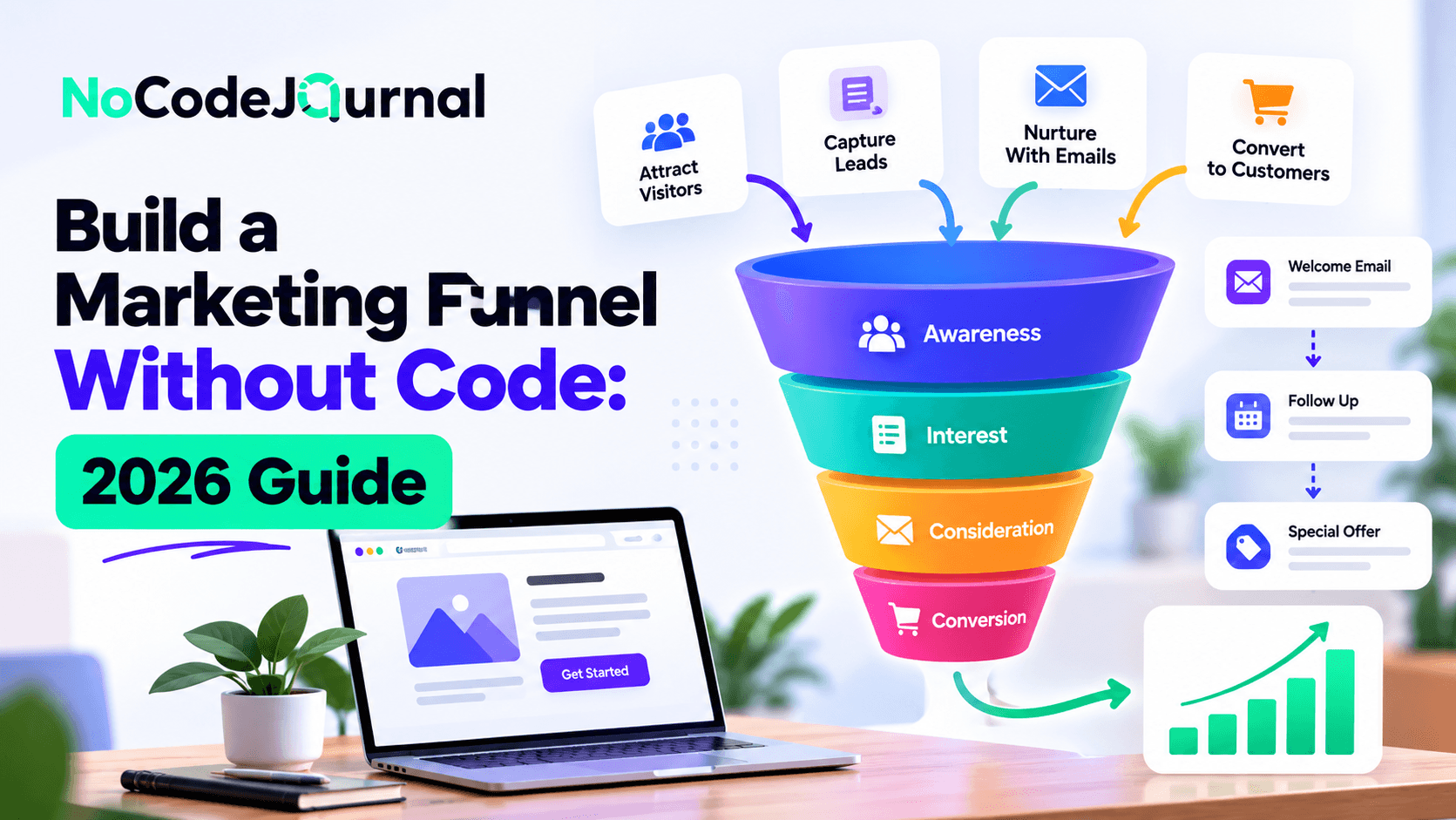
Building a marketing funnel without coding is possible using no-code tools to create landing pages, capture leads, automate email campaigns, process payments, and track conversions. Platforms such as Carrd, Kit, Zapier, and Google Analytics 4 allow entrepreneurs and small businesses to connect these steps without developing custom software. The most effective approach is to start with a clear offer, choose affordable tools for each funnel stage, and continuously improve performance using real customer data.
Best No-Code Marketing Funnel Tools and Pricing (October 2026)
|
Tool |
Starting price |
Best for |
Key limitations |
|---|---|---|---|
|
Carrd |
Free; paid plans available |
Simple landing pages |
Advanced forms and integrations require upgrades |
|
Unbounce |
$29/month |
Conversion-focused landing pages |
Starter limited to 5 pages and 500 visitors |
|
Kit |
Free; Creator $39/month |
Email marketing and lead nurturing |
Free plan excludes automated email sequences |
|
Zapier |
Free; Professional $19.99/month |
Connecting apps and automating tasks |
Free plan limited to 100 tasks/month |
|
Google Analytics 4 |
Free |
Measuring traffic and conversions |
Requires event and conversion configuration |
|
VWO |
Contact sales for suitable plan |
Website A/B testing |
Pricing and features vary by package |
Pricing as of October 16, 2026, in USD. Kit Creator price assumes 1,000 subscribers and monthly billing. Zapier Professional price uses annual billing. Other paid prices and limits should be checked before purchase.
Which No-Code Marketing Funnel Tools Should You Choose?
For beginners and small businesses, a combination of Carrd for landing pages, Kit for email marketing, Zapier for integrations, and Google Analytics 4 for conversion tracking provides a flexible starting point.
Businesses that require more advanced landing-page optimization can consider Unbounce, while growing teams may benefit from dedicated experimentation platforms such as VWO.
Start with free plans where possible, but evaluate automation limits, subscriber allowances, visitor quotas, and transaction fees before committing to a paid marketing stack.
What Is a Marketing Funnel?
A marketing funnel describes the journey a potential customer takes from discovering your business to completing a valuable action, such as making a purchase, booking a consultation, or subscribing to a service.
A typical funnel has three main stages:
Top of the Funnel (Awareness): Help potential customers discover your business through search engines, social media, recommendations, advertising, and educational content.
Middle of the Funnel (Consideration): Build interest and trust using landing pages, useful resources, email sequences, product demonstrations, and relevant information.
Bottom of the Funnel (Conversion): Help prospects make a decision through clear offers, pricing, booking processes, and checkout experiences.
The customer journey continues after conversion. Retention, referrals, and repeat purchases can be important sources of sustainable growth.
Step 1: Define Your Audience and Funnel Goal
Before choosing software, decide what you want visitors to accomplish.
For example:
-
A consultant wants visitors to schedule a discovery call.
-
A course creator wants to convert newsletter subscribers into customers.
-
An e-commerce business wants visitors to purchase a product.
-
A SaaS startup wants visitors to register for a trial.
Choose one primary conversion goal and identify the audience most likely to benefit from your offer.
Avoid designing a funnel that asks visitors to subscribe, download, book, and purchase simultaneously. A clear primary action makes the experience easier to understand and measure.
Step 2: Create a Landing Page Without Code
Your landing page introduces your offer and encourages the visitor to take the next step.
Useful tools include:
Carrd: Suitable for simple, single-page websites and lead-generation pages.
Webflow: Offers greater design flexibility for websites requiring more customization.
Framer: Provides visual website design tools for modern marketing pages.
Unbounce: Focuses on landing pages and conversion optimization.
An effective landing page generally includes a clear headline, a short explanation of the offer, a relevant image or demonstration, a prominent call-to-action button, and an accessible form or checkout process.
For example, a productivity consultant could use the headline:
"Plan Your Week in 15 Minutes With Our Free Productivity Template."
The CTA might read "Get the Free Template."
The promise should accurately describe what the visitor receives. Avoid unsupported guarantees about conversions, revenue, or productivity improvements.
Step 3: Build a Lead Magnet
A lead magnet provides useful value in exchange for a visitor's contact information.
Examples include checklists, templates, short educational guides, practical worksheets, and introductory courses.
Tools such as Canva, Notion, and Google Docs can help create these resources.
The strongest lead magnets address a narrow, specific problem. A short, practical checklist may be more useful than a lengthy generic ebook.
Only request information necessary for your stated purpose. Where required, obtain appropriate marketing consent and explain how contact details will be used.
Step 4: Capture Leads and Automate Email Follow-Ups
Once someone submits a form, the next step is to deliver the promised resource and begin a relevant email sequence.
Potential tools include:
Kit (formerly ConvertKit): Email marketing, forms, landing pages, subscriber management, and automation for creators.
MailerLite: Newsletters, signup forms, and email automation.
Brevo: Email marketing and customer communication features.
ActiveCampaign: Email automation, segmentation, and customer journey workflows.
You can connect these services with Zapier or Make when a suitable native integration is unavailable.
Example email sequence
Day 1 — Welcome: Deliver the lead magnet and explain what the subscriber can expect.
Day 2 — Education: Share one useful technique related to the visitor's problem.
Day 3 — Practical example: Demonstrate an application or relevant customer use case.
Day 5 — Offer: Introduce your service or product, with clear pricing or next steps.
Day 7 — Follow-up: Answer common questions and offer an appropriate next action.
Keep messages relevant and provide unsubscribe functionality. Avoid sending promotional sequences without suitable permission.
Kit Pricing in 2026
Kit, previously known as ConvertKit, has updated its branding and pricing.
| Kit plan | Indicative cost | Suitable for |
|---|---|---|
| Free Newsletter | $0/month | Basic newsletters, forms, and landing pages, up to 10,000 subscribers |
| Creator | From $39/month, paid monthly | Creators needing email sequences and more advanced automation |
| Pro | From approximately $79/month, paid monthly | More advanced creator businesses |
These indicative paid prices assume approximately 1,000 subscribers. Annual billing, subscriber counts, promotions, and other conditions affect the total.
The free Newsletter plan should not be treated as equivalent to Creator's automation features. Check Kit's official pricing before budgeting.
Step 5: Connect Your Funnel With Automation
No-code automation tools move information between compatible applications.
For example:
-
A visitor submits a Tally form.
-
Zapier adds the subscriber to Kit, subject to the configured permissions and subscription requirements.
-
Kit delivers a welcome message.
-
Relevant lead information is recorded in Airtable.
-
The subscriber receives appropriate follow-ups.
Zapier offers a broad range of application connections and beginner-friendly workflows.
Make offers a visual environment for workflows with branching logic and multiple processing steps.
These tools may require paid plans as your usage increases. Test every integration, especially error handling, duplicate submissions, and consent status.
Step 6: Design Your Sales Page and Checkout
For a purchase-focused funnel, the sales page should help visitors understand the product, its benefits, the price, and the purchase process.
Useful tools include Stripe Checkout, Gumroad, Payhip, and supported course-selling or commerce platforms.
Your sales page should contain accurate product information, transparent pricing, a visible CTA, and authentic reviews or testimonials if available.
Avoid artificial scarcity, fabricated customer results, and misleading guarantees.
Before launching, test the entire checkout flow, including payment failures, confirmation emails, refunds, and post-purchase access where applicable.
Step 7: Measure Funnel Performance
A funnel should be evaluated using real data rather than assumptions about what visitors might do.
Useful tools include Google Analytics 4, Fathom, and Microsoft Clarity, depending on your tracking needs and privacy requirements.
Key metrics include:
| Metric | What it tells you |
|---|---|
| Landing page conversion rate | Percentage of visitors completing the target action |
| Cost per lead | Acquisition spending divided by leads generated |
| Email click-through rate | How subscribers engage with email links |
| Sales conversion rate | How many qualified prospects become customers |
| Customer acquisition cost | Cost of acquiring a customer |
| Retention rate | Whether customers continue using or buying your product |
| Revenue per customer | How much revenue customers generate over a defined period |
For example, if 500 people visit a landing page and 25 submit a lead form, the conversion rate is 5%.
Compare performance across meaningful time periods and audience segments. Small samples can be noisy, so avoid treating every short-term change as a proven improvement.
Step 8: A/B Test Your Funnel
A/B testing compares two versions of an experience to determine whether a change improves a defined outcome.
You might test a landing page headline, CTA wording, form length, email subject line, or pricing presentation.
What happened to Google Optimize?
Google Optimize and Optimize 360 were discontinued on September 30, 2023. They should no longer be recommended as active experimentation platforms.
Instead, evaluate tools such as:
-
VWO — Website experimentation and optimization
-
Optimizely — Experimentation and digital experience tools
-
AB Tasty — Experimentation and personalization
These are examples of alternatives, not necessarily free or interchangeable replacements. Confirm product suitability, current features, and pricing with the provider.
For an early-stage business, it may be more useful to start with analytics and user feedback before purchasing a dedicated experimentation platform.
Define your success metric before launching a test, and avoid declaring a winner based only on a small number of initial conversions.
Step 9: Apply Growth Hacking Strategies
Growth hacking focuses on systematic experimentation across acquisition, activation, retention, referrals, and revenue.
The objective isn't simply to attract more traffic. It's to learn which channels and improvements create sustained customer value.
Search Engine Optimization
Create helpful content around problems your audience is actively researching.
Use clear page titles, descriptive URLs, useful internal links, and technically accessible pages.
SEO is generally a longer-term acquisition channel rather than an instant traffic source.
Content and Social Distribution
Publish educational articles, tutorials, product demonstrations, and relevant social media content.
Repurpose useful ideas across formats, but adapt them to each platform and audience.
Referral Programs
If customers value your product, consider making it easy for them to recommend it.
Referral credits, discounts, or rewards may be appropriate when the incentives are transparent and economically sustainable.
Product-Led Growth
For software products, an accessible trial, useful onboarding experience, and shareable product features can support adoption.
Measure whether new users successfully reach the product's core value rather than focusing solely on registrations.
Partnerships and Communities
Collaborate with complementary businesses, creators, and relevant communities.
Participate through genuinely useful contributions rather than repetitive unsolicited promotion.
Step 10: Use the AARRR Framework
The AARRR framework helps startups understand growth beyond the first conversion.
Acquisition: How do people discover the product?
Activation: Do new users experience meaningful value?
Retention: Do they continue using or buying?
Referral: Do satisfied users recommend the product?
Revenue: Does the business generate sustainable income?
For a SaaS business, acquisition might be measured by registrations, activation by completing a meaningful first action, and retention by continued usage after several weeks.
These metrics help identify whether an apparent traffic problem is actually an onboarding or customer-retention problem.
Step 11: Launch a Simple Funnel Quickly
Here's a practical example for a freelance consultant selling a digital productivity workshop.
Offer: A free weekly planning template followed by an optional paid workshop.
Landing page: Carrd, with a clear description and download CTA.
Lead form: Tally, collecting the information needed to deliver the resource.
Email marketing: Kit, for subscriber management and an appropriate follow-up sequence.
Automation: Zapier or a native integration, if required.
Payment: Stripe Payment Links, subject to regional and business eligibility.
Analytics: GA4 or another suitable analytics solution.
A suggested one-day launch plan
| Stage | Activity |
|---|---|
| Morning | Define the offer, target audience, and success metric |
| Midday | Build the landing page and signup form |
| Afternoon | Connect email delivery and prepare follow-ups |
| Late afternoon | Test analytics, mobile layout, forms, and checkout |
| Before launch | Verify consent, disclosures, links, and error handling |
A simple version may be possible in a day, but more complex requirements can take longer.
The objective is to launch a functional, accurate experience—not to guarantee results within a fixed timeline.
How Much Does a No-Code Marketing Funnel Cost in 2026?
The total cost depends on the tools you select, subscriber volume, traffic, features, and payment processing.
For a small pilot, some platforms have free plans, but businesses should not assume a complete production funnel will always cost less than $50 per month.
Consider these budget categories:
| Component | Budget consideration |
|---|---|
| Landing page | Free or paid, depending on branding and domains |
| Lead form | Free-tier limits and submission volume |
| Email marketing | Subscriber count and automation features |
| Integrations | Workflow runs and tasks |
| Checkout | Transaction charges and other applicable fees |
| Analytics | Free solutions or paid privacy/behavior tools |
| A/B testing | Dedicated tools may substantially increase costs |
For one concrete benchmark, Kit Creator starts at $39 per month with monthly billing for 1,000 subscribers. Additional paid services can therefore move a funnel's cost beyond $50.
Consult official pricing pages before purchasing. Tool pricing can change, and regional taxes or fees may apply.
Common Funnel Mistakes to Avoid
Adding too many platforms: Every additional tool creates cost, configuration, and maintenance requirements.
Using generic offers: A vague benefit provides little reason for visitors to act.
Ignoring mobile design: Forms and payment flows must work well on smaller screens.
Collecting too much personal information: Ask only for what you need and manage consent appropriately.
Skipping testing: Always complete a trial signup and transaction flow where applicable.
Focusing entirely on acquisition: More traffic won't solve an onboarding or retention problem.
Using outdated tools and prices: Verify current provider names, services, pricing, and product availability before publishing recommendations.
Frequently Asked Questions
Can you build a marketing funnel without coding?
Yes. Many landing pages, lead forms, email workflows, and checkout systems can be built with visual tools. Some complex integrations may still require technical assistance.
Is Google Optimize still available?
No. Google Optimize and Optimize 360 were discontinued on September 30, 2023.
Is ConvertKit now called Kit?
Yes. Kit is the current brand name of the email marketing platform previously called ConvertKit.
Can you build a funnel for free?
It may be possible to create a basic pilot using free plans, subject to platform limitations. Production-ready funnels may require subscriptions and transaction fees.
How can startups grow a funnel without large advertising budgets?
Start with useful content, search optimization, partnerships, communities, referral opportunities, and ongoing improvements informed by customer behavior.
Which metric should I improve first?
Start with the metric most closely related to your objective. For lead generation, that might be qualified submissions. For SaaS, activation and retention may be equally important.
Final Thoughts
Building a marketing funnel without code is easier when you focus on the customer journey rather than collecting as many tools as possible.
Start with one audience, one compelling offer, one landing page, and a reliable way to follow up.
Then use analytics and customer feedback to identify improvements.
Growth becomes more sustainable when acquisition, activation, retention, referrals, and revenue work together—not when success depends on a single landing page or marketing campaign.