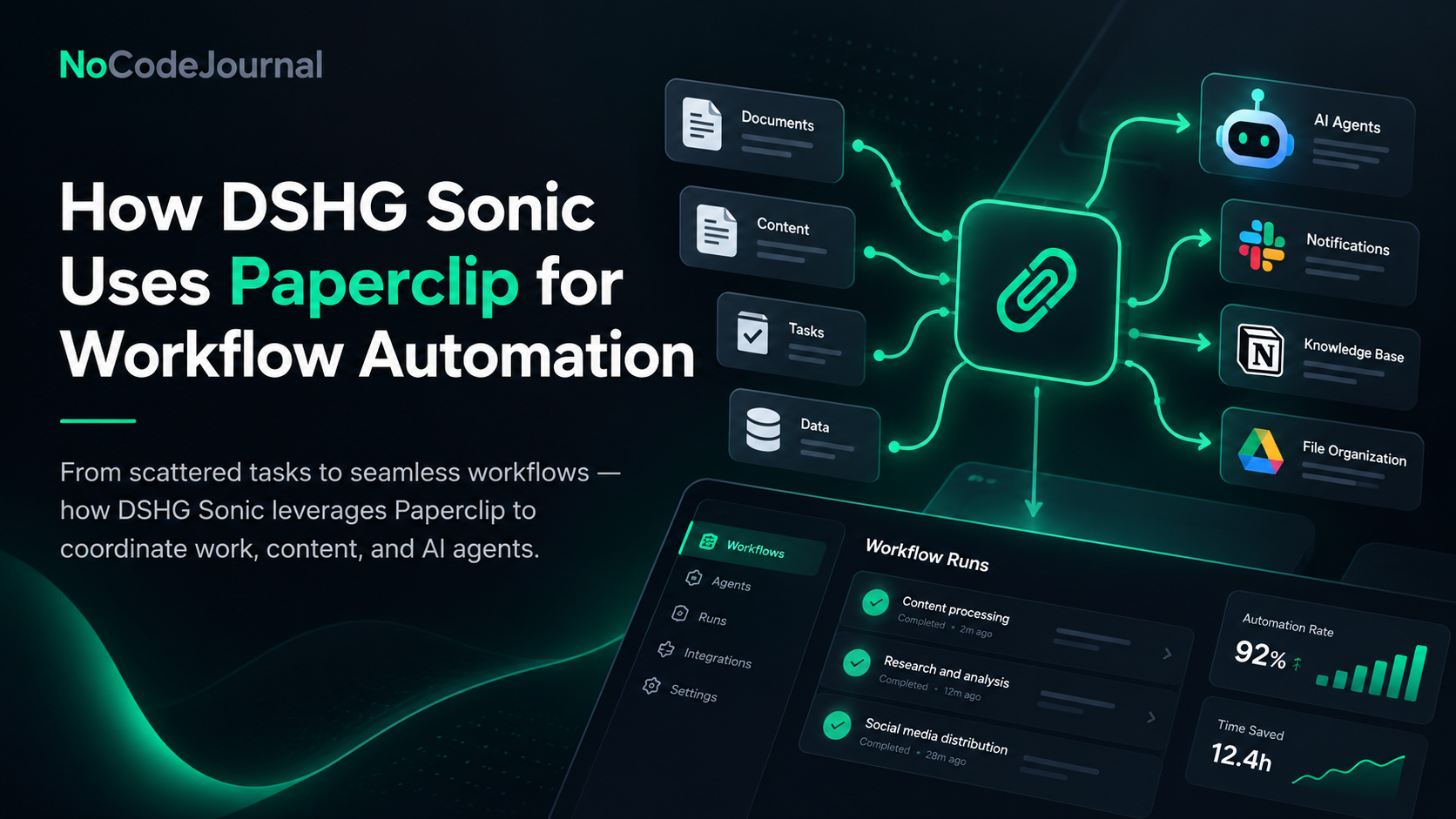
Content creation has become an essential part of modern business growth. From blog articles and social media posts to product documentation and marketing campaigns, organizations constantly need high-quality content to attract customers and communicate their value.
But creating content is only one part of the challenge.
Businesses must also coordinate tasks, assign responsibilities, review drafts, manage approvals, and ensure that every piece of content supports their overall business objectives.
As content demands increase, traditional workflows can become difficult to manage.
This is where artificial intelligence and workflow automation are changing the way teams operate.
DSHG Sonic, an AI-native startup studio specializing in digital product development, provides a useful example of how AI-agent orchestration can support more structured content and business workflows.
Paperclip, an open-source platform for managing teams of AI agents, offers a framework for coordinating these processes through assigned responsibilities, task tracking, automation, and human oversight.
Rather than treating AI as a collection of disconnected chat sessions, Paperclip allows organizations to manage agents as coordinated teams working toward shared goals.
In this article, we'll explore how Paperclip can support DSHG Sonic's content operations, the benefits of AI-driven workflows, and the practical strategies businesses can use to improve productivity.
What Is PaperClip?
Paperclip is an open-source AI-agent orchestration platform designed to coordinate multiple artificial intelligence agents within a structured organizational environment.
Instead of assigning unrelated prompts to different AI tools, users can organize agents into teams, define responsibilities, assign tasks, and track progress through a centralized interface.
Paperclip works with supported AI-agent runtimes, including Claude Code, Codex, and other compatible systems.
Its main purpose is coordination.
The platform provides a management layer for organizing the work performed by different agents.
How Paperclip Works
Paperclip uses several important concepts.
Goals: Define the outcomes an organization wants to achieve.
Agents: AI-powered workers assigned specific responsibilities.
Tasks: Individual activities connected to broader objectives.
Organizational Structure: Defines which agents are responsible for different functions.
Approval Workflows: Establish checkpoints for reviewing important actions.
Monitoring: Provides visibility into task progress, execution activity, and resource consumption.
For example, a content marketing team could assign one agent to research a topic, another to prepare a draft, and another to perform a preliminary quality review.
A human editor would then verify the results before publication.
This approach combines automation with accountability.
Understanding DSHG Sonic's Approach to AI-Native Operations
DSHG Sonic operates as an AI-native startup studio focused on turning business ideas into digital products.
The studio's work includes application development, AI integration, automation, and technology solutions for startups and businesses.
Managing these activities can involve substantial coordination.
Product teams need documentation, marketing teams need content, and project managers need visibility into deliverables.
AI-driven workflows provide an opportunity to streamline repetitive activities while maintaining human oversight.
Why Workflow Automation Matters
Consider a typical content production process.
A marketing team identifies a topic, conducts research, creates an outline, prepares a draft, reviews the content, and schedules publication.
Each activity may involve different tools or people.
Without clear ownership, tasks can become delayed or duplicated.
An AI-agent orchestration platform can organize these activities into a consistent workflow.
At DSHG Sonic, this approach is particularly relevant because content, software development, and AI automation are closely connected business functions.
For readers exploring the broader advantages of visual tools and automation, our guide on the benefits of NoCode development explains how businesses can reduce repetitive work and improve operational flexibility.
1. Centralizing Content Workflow Management
One of the most important challenges in content operations is keeping tasks organized.
Content teams frequently work with spreadsheets, documents, messaging applications, and project management systems.
When information is scattered, understanding the status of a project becomes difficult.
Paperclip provides a centralized environment for organizing AI-agent tasks and tracking progress.
A Centralized Content Operations Model
Consider a DSHG Sonic marketing initiative focused on publishing educational articles about AI and software development.
The team could establish a content production goal within Paperclip.
Individual tasks could then be created for topic research, outlining, drafting, technical review, and publication preparation.
Each task would have a defined owner.
This structure would help team members understand which activities are in progress and which require attention.
Why Centralization Matters
Centralized task management can reduce ambiguity.
It helps organizations establish clear responsibilities and maintain records of decisions.
However, Paperclip should not be confused with a traditional document editor.
Its primary role is orchestrating agent activities, while content may be created or edited using connected tools.
2. Automating Content Research and Topic Discovery
Research is an important part of producing useful content.
Writers must understand their audience, identify relevant questions, review reliable sources, and organize information.
These activities can consume significant time.
AI agents can assist by gathering and structuring research materials through appropriately connected tools.
Example: Researching a Blog Topic
Suppose DSHG Sonic wants to publish an article about AI-powered application development.
A research agent could receive instructions to identify relevant themes, collect source references, and organize key questions.
Another agent could evaluate the research against an editorial brief.
The output could then be passed to a content-writing agent.
Maintaining Research Quality
AI-generated research should not be treated as automatically accurate.
A reliable workflow needs source verification.
Human reviewers should check technical statements, recent product developments, and any claims involving performance or business results.
This is particularly important for rapidly changing topics such as AI models, software tools, and emerging automation platforms.
The goal is to make research more efficient without sacrificing accuracy.
3. Streamlining AI-Assisted Content Creation
Writing high-quality content requires planning, organization, editing, and subject-matter understanding.
AI agents can help with several stages of this process.
For example, a content agent could turn an approved outline into an initial article draft.
Another agent could review readability and structure.
A human editor would then refine the content and ensure it accurately represents the organization.
A Practical Content Creation Workflow
An illustrative DSHG Sonic workflow could include:
-
A marketing manager defines the article topic and audience.
-
A research agent gathers relevant information.
-
A writing agent prepares the first draft.
-
An editorial agent identifies clarity and consistency issues.
-
A human reviewer verifies facts and approves the final content.
-
The approved article is transferred to the publishing system.
Paperclip can coordinate the responsibilities and task transitions within this process.
The Importance of Human Editing
Automation should support content teams rather than eliminate editorial judgment.
Human reviewers remain responsible for originality, technical accuracy, useful examples, and brand authenticity.
An AI-generated article may be grammatically correct while still containing inaccurate or generic information.
Successful content operations require both speed and quality control.
4. Improving Collaboration Between AI Agents and Human Teams
Traditional workflows often depend on people manually coordinating every task.
A project manager may repeatedly ask for updates, assign new activities, and follow up on delayed deliverables.
Paperclip introduces a structured model where AI agents can receive responsibilities and report progress.
Clear Roles and Responsibilities
For a content production workflow, an organization could define roles such as:
Content Strategist: Identifies topics and content objectives.
Research Agent: Collects relevant information and source material.
Writing Agent: Produces initial drafts based on approved requirements.
Quality Review Agent: Checks structure, consistency, and selected requirements.
Human Editor: Reviews factual accuracy, brand voice, and publication readiness.
Publishing Coordinator: Manages approved content distribution.
Paperclip's organizational model supports assigned roles and task ownership.
This makes it easier to identify who is responsible for each activity.
Collaboration Beyond Marketing
The same approach can apply to product documentation, customer support knowledge bases, and internal technical content.
For example, a development team could use agents to prepare initial documentation while engineers verify technical details.
This creates opportunities for coordination across multiple business functions.
5. Creating Structured Review and Approval Workflows
Content approval is a critical part of professional publishing.
An article may need to pass through editorial, technical, legal, or brand reviews before publication.
Without a structured process, approvals can become fragmented.
Paperclip supports task reviews and approval checkpoints.
How Approval Workflows Help
Imagine an AI agent completes a technical blog article.
Rather than allowing the content to be published automatically, the task could move into a review stage.
A human reviewer could inspect the draft, request corrections, or approve the work.
The decision would remain connected to the task.
This provides greater visibility into how content reaches its final version.
Preventing Unapproved Publication
Organizations should treat public publishing as a controlled action.
AI agents should not automatically publish content containing unverified claims, confidential information, or unauthorized customer references.
A human approval stage creates an additional safeguard.
This approach aligns with DSHG Sonic's publicly stated responsible AI principles, which emphasize human oversight and clear boundaries for AI-agent actions.
6. Maintaining Brand Consistency Across Content
As companies publish more frequently, maintaining consistent messaging becomes increasingly important.
Different articles may be written by different people or AI tools.
Without shared instructions, content can become inconsistent in tone, terminology, and structure.
Creating Editorial Standards
DSHG Sonic could define editorial guidelines covering:
-
Brand voice and communication style.
-
Intended audience.
-
Preferred terminology.
-
Technical accuracy requirements.
-
Article formatting.
-
SEO considerations.
-
Source verification.
-
Internal and external linking.
These guidelines can be incorporated into reusable agent instructions or skills.
Benefits of Standardization
Consistent instructions make it easier to produce content that reflects an organization's identity.
They can also reduce repetitive editorial corrections.
However, standardization shouldn't result in generic content.
Writers and editors should still tailor each article to the subject, audience, and search intent.
7. Connecting Content Production With SEO
Search engine optimization is an important component of long-term content marketing.
SEO helps businesses create content that addresses relevant questions and can be discovered through search engines.
AI workflows can support keyword research, article structuring, and editorial checks.
An SEO-Focused Content Process
A content team could begin by identifying a target keyword.
A research agent could organize related questions and search intent.
A writing agent could prepare content using an approved structure.
A quality review agent could examine headings, links, and readability.
A human editor would then ensure that the final article genuinely answers the reader's question.
Why SEO Still Requires Judgment
Keyword placement alone doesn't make content valuable.
Articles need original insights, accurate explanations, useful examples, and a clear purpose.
Businesses should avoid producing large volumes of repetitive AI-generated content simply to target search queries.
For startups developing broader organic acquisition strategies, our article on growth hacking strategies for global startups explores how SEO and experimentation can support sustainable growth.
8. Automating Repetitive Workflow Activities
Content operations include numerous administrative tasks.
Examples include assigning work, requesting reviews, tracking deadlines, and notifying stakeholders when activities are complete.
Automating selected steps can reduce manual coordination.
Task-Based Automation
Paperclip supports agent tasks, recurring routines, and scheduled execution patterns.
For example, an organization could configure a recurring task for reviewing its upcoming editorial priorities.
The assigned agent could prepare a summary or identify outstanding work.
A manager could then review the results and make decisions.
Why Automation Needs Boundaries
Not every action should happen without supervision.
Routine research summaries may require relatively little intervention.
Publishing content, changing production systems, or sharing confidential information may require approval.
Businesses should distinguish between low-risk automated activities and actions that need human authorization.
This helps maintain control as automation expands.
9. Using Paperclip With Existing AI Tools
Paperclip is an orchestration platform rather than a standalone language model.
It coordinates work performed by compatible AI agents and their runtimes.
This distinction is important.
For example, organizations can use supported coding or agent tools for execution while Paperclip manages tasks, roles, and progress.
Benefits of a Model-Agnostic Approach
Different AI systems may perform better on different tasks.
One system might be useful for drafting technical documentation.
Another could assist with reviewing code or organizing research.
A model-agnostic orchestration layer can allow organizations to use different tools according to their requirements.
Paperclip's open-source GitHub repository describes supported agent runtimes, task management, organizational structures, and governance capabilities.
Before deploying integrations, teams should review compatibility, access permissions, infrastructure requirements, and operating costs.
10. Managing AI Costs and Resource Usage
AI automation introduces operational costs.
Different models and workflows may consume varying amounts of computational resources.
Without appropriate oversight, frequent agent execution can increase expenses.
Paperclip includes mechanisms for managing budgets and tracking agent-related activity.
Why Budget Controls Matter
Imagine a content team creating several research and writing tasks each day.
If every task uses an expensive model or unnecessarily repeats previous work, operating costs may rise.
Organizations can reduce waste by assigning suitable tools to different tasks and monitoring usage.
For example, a simple classification activity may not require the same resources as complex technical research.
Measuring Operational Efficiency
Businesses should monitor:
-
AI execution costs.
-
Number of completed tasks.
-
Average workflow duration.
-
Human review time.
-
Rework frequency.
-
Publication throughput.
These metrics help determine whether automation provides meaningful operational value.
11. Extending Automation Into Marketing Campaigns
Content creation and marketing operations are closely connected.
A completed blog article can support email newsletters, social media campaigns, sales enablement, and customer education.
An organized workflow helps teams repurpose information across these channels.
Example: One Article, Multiple Assets
Suppose DSHG Sonic publishes an educational article about startup MVP development.
A coordinated workflow could create:
Blog article: A detailed explanation of the topic.
LinkedIn post: A shorter professional summary.
Email newsletter: Key insights for subscribers.
Social media captions: Concise messages highlighting individual ideas.
Sales resource: A relevant educational reference for potential customers.
Each asset would still require appropriate review.
Connecting Content With Lead Generation
Publishing content is most useful when it supports a clear business objective.
Educational articles can direct readers to related services, newsletter subscriptions, or contact forms.
Our NoCode Journal guide on building a marketing funnel without code explains how landing pages, forms, and automated emails can support these activities.
Paperclip could coordinate the preparation of marketing assets, while specialized tools handle distribution and customer communications.
12. Building an Organized Content Knowledge Base
Content teams accumulate valuable information over time.
Research notes, article outlines, editorial decisions, and product explanations can become useful resources for future projects.
However, this information is less valuable when it's difficult to locate.
Paperclip maintains task-related records, comments, and documents to preserve project context.
Benefits of Persistent Context
Persistent context helps teams understand why decisions were made.
For example, a future content agent could review an earlier task's requirements and supporting materials when preparing a related assignment.
This can reduce unnecessary repetition.
However, a task management record isn't automatically a complete company knowledge base.
Organizations may still need document repositories, search systems, and data governance practices.
13. Measuring the Success of Content Automation
The success of an automated workflow should be measured through business outcomes, not simply the number of AI tasks completed.
Producing more content isn't useful if that content lacks accuracy or fails to serve readers.
Key Performance Indicators
Content Production Time: How long it takes to move from an approved brief to a publication-ready asset.
Review Cycles: The number of revisions required before approval.
Content Quality: Editorial accuracy, clarity, and usefulness.
Publishing Consistency: Whether approved content is delivered according to schedule.
Operational Cost: Total time and AI-related expenditure per completed asset.
Business Impact: Organic traffic, qualified inquiries, engagement, and customer conversions.
Establish a Baseline
Before making claims about productivity improvements, organizations should measure their existing workflow.
For example, record the average time required to create and approve an article before introducing automation.
Then compare results after implementation.
This creates a more reliable understanding of whether Paperclip improves efficiency.
Publicly available claims about DSHG Sonic's content production improvements should be treated as reported outcomes unless independently verified through operational records.
14. Challenges of AI-Driven Content Workflows
Although AI orchestration offers advantages, businesses should also consider the risks.
Inaccurate Information
AI-generated content may include incorrect or outdated statements.
Human verification remains necessary.
Inconsistent Outputs
Different AI agents may interpret instructions differently.
Clear task descriptions and editorial standards help reduce inconsistency.
Security and Privacy
Agents should receive access only to the systems and information needed for their assigned activities.
Integration Complexity
Connecting multiple AI tools and external applications can require technical configuration.
Over-Automation
Automating every decision may reduce accountability and increase the risk of mistakes.
Quality Control
Organizations need clear criteria for determining when work is ready for publication.
The most effective automation strategy balances efficiency with human responsibility.
15. How Businesses Can Implement a Paperclip Content Workflow
Organizations interested in AI-agent coordination can begin with a small pilot project.
Step 1: Identify a Repeatable Workflow
Choose a process that occurs frequently and has clearly defined stages.
Content research and article preparation can be suitable starting points.
Step 2: Define the Desired Outcome
Specify what the completed work should include.
For an article, this could mean an approved outline, verified references, editorial review, and publication-ready formatting.
Step 3: Assign Agent Responsibilities
Define which agents handle research, drafting, and preliminary quality checks.
Keep their responsibilities clearly separated.
Step 4: Configure Permissions
Limit each agent's access to relevant systems and information.
Require authorization for sensitive actions.
Step 5: Establish Review Checkpoints
Introduce human approval before final publication.
Step 6: Test the Workflow
Run sample tasks and evaluate their outputs.
Identify errors, unnecessary steps, and coordination problems.
Step 7: Monitor Costs and Performance
Measure task duration, review effort, output quality, and AI usage.
Step 8: Expand Gradually
Once the initial workflow performs reliably, introduce additional content formats or departments.
Businesses managing simpler database-driven workflows may also benefit from exploring Stackby as a NoCode tool, which provides a different approach to organizing information and automating operational tasks.
The Future of AI-Agent Workflow Automation
AI automation is evolving beyond individual prompts and isolated chat sessions.
Organizations are increasingly exploring systems that coordinate multiple specialized agents toward shared business goals.
This approach can support more structured work across marketing, development, research, operations, and customer support.
Paperclip represents this emerging category of AI-agent orchestration.
Its focus on organizational structures, task ownership, persistent context, budget monitoring, and approval controls demonstrates how agent-based workflows can be managed more systematically.
However, the future of workplace automation should not be interpreted as eliminating human decision-making.
Successful businesses will continue to depend on people to establish objectives, verify quality, manage risk, and maintain customer relationships.
The strongest implementations will use AI to reduce repetitive work while preserving human accountability.
From Content Automation to Customer Acquisition
A coordinated content workflow becomes even more valuable when it's connected to a customer acquisition strategy.
For example, DSHG Sonic could use AI agents to research customer problems, prepare educational articles, and develop marketing assets. Approved content could then direct readers toward landing pages, lead forms, and relevant services.
Businesses interested in connecting these activities can explore our guide on building a funnel fast with NoCode tools.
For teams implementing agent-based operations, the official Paperclip documentation explains how company goals, agent roles, task execution, and human decision-making fit together.
Combining structured content operations with clear conversion pathways can help businesses connect publishing activity to measurable commercial outcomes.
Conclusion: How Paperclip Can Improve DSHG Sonic's Content Operations
Paperclip offers a structured approach to managing AI-driven content and workflow automation.
Rather than relying on disconnected AI sessions, organizations can assign agents specific responsibilities, connect tasks to broader goals, and establish review checkpoints.
For an AI-native startup studio such as DSHG Sonic, these capabilities are relevant to content creation, technical documentation, marketing operations, and internal workflow management.
Paperclip can help coordinate research, draft preparation, quality checks, recurring tasks, and human approvals.
However, the actual benefits depend on workflow design, integration quality, editorial standards, and measurable performance.
The real opportunity isn't simply producing more content with AI. It's creating a coordinated system where automation supports better-quality work, clearer accountability, and more efficient execution.
By combining AI-agent orchestration with human oversight, businesses can build content operations that are more structured, adaptable, and ready to scale.
Frequently Asked Questions
What is Paperclip AI?
Paperclip is an open-source platform for coordinating multiple AI agents through tasks, goals, organizational structures, budgets, and approval workflows.
How can DSHG Sonic use Paperclip?
DSHG Sonic can use Paperclip to coordinate AI-assisted content research, drafting, reviews, documentation, and other structured business workflows. Specific live implementations should be confirmed with the company's operational team.
Is Paperclip a NoCode tool?
Paperclip provides a visual management interface, but configuring agent runtimes, integrations, and infrastructure can require technical knowledge. It's more accurately described as an AI-agent orchestration platform.
Can Paperclip automatically write blog articles?
Paperclip can coordinate compatible AI agents that perform writing tasks. The actual content generation happens through connected agent tools or models.
Does Paperclip support human approvals?
Yes. Paperclip supports review workflows and governance controls for selected tasks and actions.
Can Paperclip work with different AI models?
Yes. Its model-agnostic approach supports compatible agents running through different tools and runtimes.
Is Paperclip suitable for marketing teams?
It can be useful for organizations that want structured AI-agent workflows for research, content preparation, campaign planning, and related activities.
Can Paperclip replace traditional project management software?
Paperclip specializes in coordinating AI-agent work. It may complement existing project management systems, but its suitability as a replacement depends on organizational needs.
How should businesses measure Paperclip's effectiveness?
Useful metrics include workflow completion time, human review effort, output quality, AI execution costs, and the business results generated by completed work.
What is the biggest benefit of Paperclip?
Its main advantage is coordinating multiple AI agents under shared goals with defined responsibilities, task tracking, and governance.